


Loading Content..

Shakyamuni Buddha appeared in this world with the sole purpose of benefitting all sentient beings. Out of great compassion Lord Buddha revealed many different means/paths to enlightenment and set forth three Wheels of Law to suit varying degrees of intelligence and receptivities.
Shakyamuni Buddha himself was, it is said, in the form of Vajradhara while he was teaching tantric path to his gifted disciples.
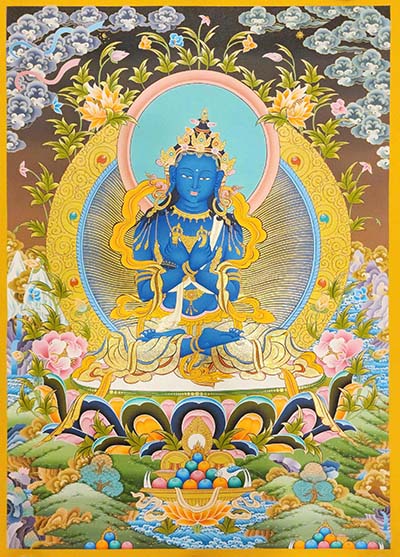
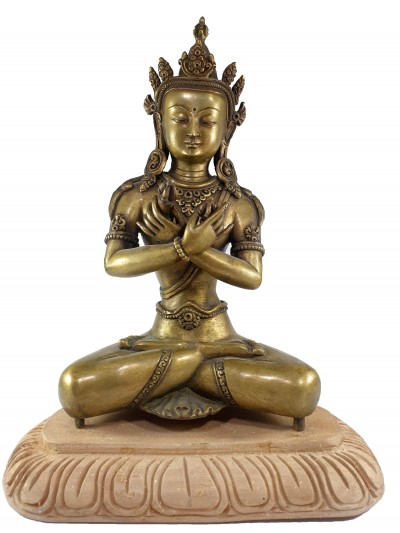
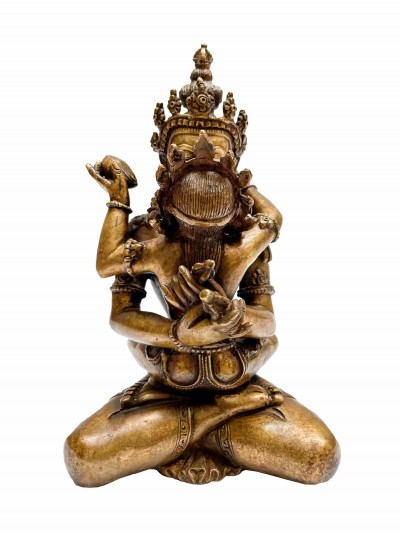
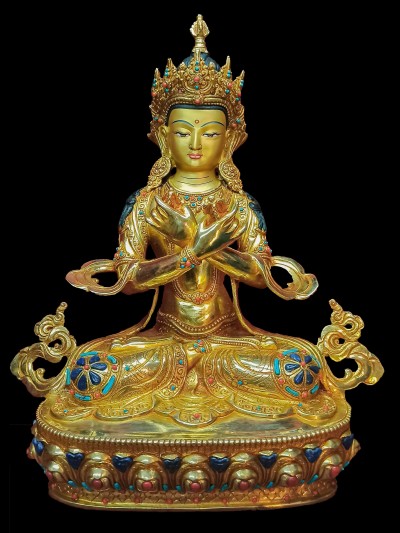
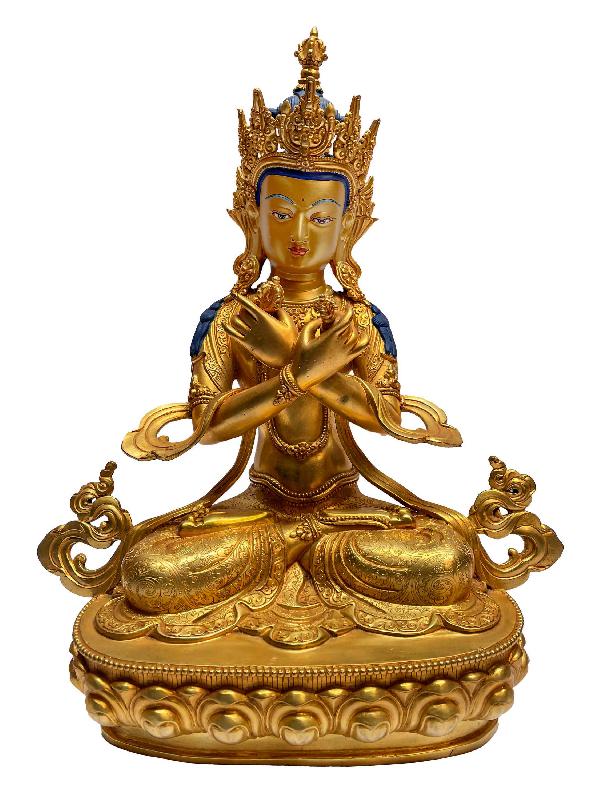
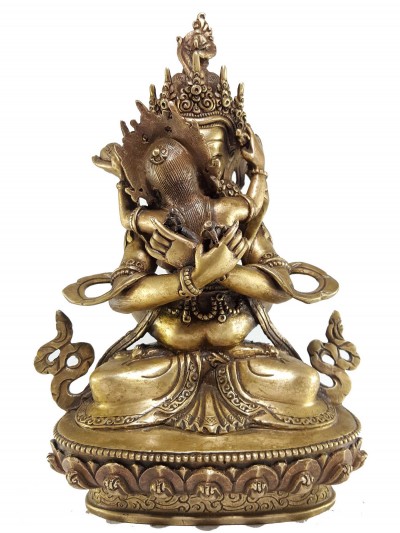
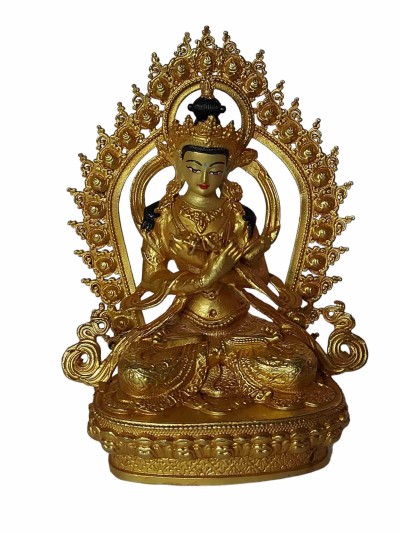
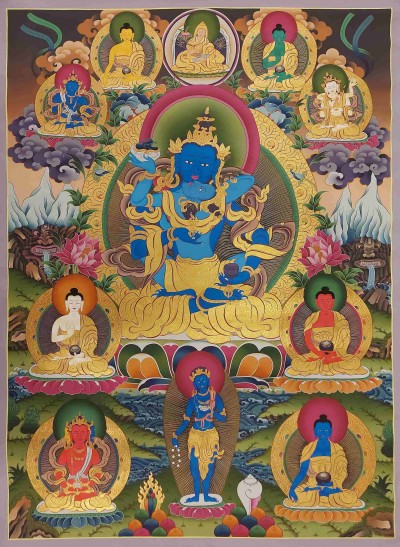
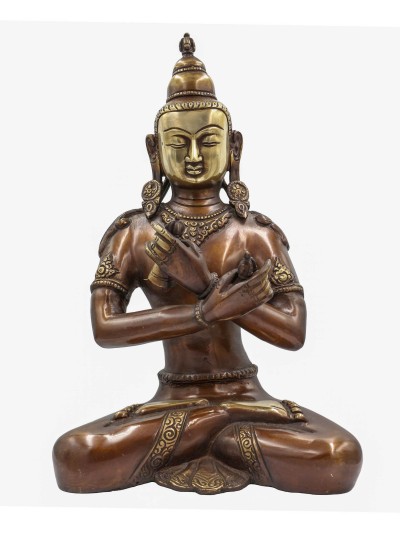
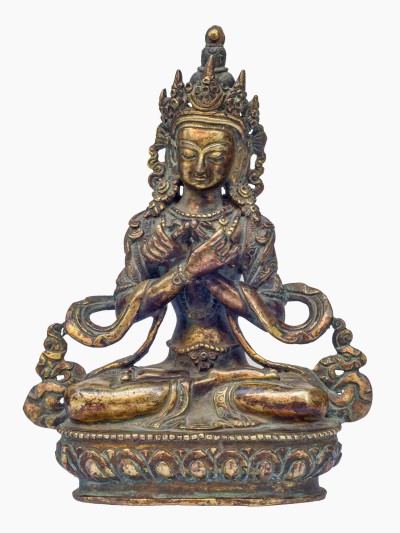
Vajradhara is depicted holding a Vajra and a bell in his left hand and his arms are kept crossed in front of him expressing complete integration of Prajna and Upaya. He is usually depicted in blue colour in vajraparyanka posture. He has a crown, an Urna and an Ushnisha as a Sambhogakaya Buddha. Vajradhara is also depicted in father-mother (Anju-Aji in Newari) aspect. en he holds his usual symbols while his arms are crossed at the back of his consort. the consort is none other than Prajnaparamita in deified form.
The Kargyudpa lineage of Tibetan Buddhism begins with the Buddha Vajradhara. The individual in this tradition is allowed to visualize his root Guru as Buddha Vajradhara. Guru Tilopa is said to have received Mahamudra instruction directly from Buddha Vajradhara through visions and other extraordinary means.
In Nispannayogavali, Vajradhara is the main deity in Vajrasattvamandala. He is three faced, six-armed and reddish white in color. His right arm holds a vajra, a sword and a kapala and his left hand holds a bell, an ankush and a noose. He stands in the Ardhaparyanka posture and dances in Tandava style.
This image represents the understanding & application of internal & external tantric energy, by skilfully influencing & directing energies arising from everyday experiences [Skt. dharmas]. Vajradhara expresses not just the awoken mind but the direction of understanding which develops into a transcendent experience of the Dharmakaya. This is symbolised by the lightening [Skt. vajra] headed bell [Skt. ghanta] which represents the feminine creative wisdom and the double ended lightening sceptre representing 'energy', method & the masculine. Vajradhara personifies the ways [bell] & means [lightening sceptre] to objectively transform experience beyond everyday conception of space & time.
Dharmakaya is often taken to mean the 'truth body' & is one of the three Forms of or realms of understanding [Skt. Trikaya]. The Principle of Non-Duality i.e. the 'union of two' is represented in the Bell [Skt. Ghanta] & the Lightning sceptre [Skt. Vajra]. The bell embodies female wisdom & the Diamond Sceptre being compassion or method. The truth body of Vajradhara and Vajrayana tools will empower your journey in all places. This involves unlocking the mysteries or obscuration's of the material & inner world through methods of tantric practice & understanding. In fact Vajradhara represents latent power of transformation using tantric through wisdom to allow us to uncover Great Bliss. Vajradhara the realised way of method. Since Vajradhara personifies the essence of non dualitic union the figure represents a mastery of the symbols portrayed in other tantric deities & having understood their meaning does not need to bear them.
Iconography
The name Vajradhara means the bearer of the lightning sceptre. The inherent tradition of lightning representing transformation & energy originates 2,500 c. BCE. The term Vajra is a typical Sanskrit word being a composite of va- meaning to bear or carry, ja or ja whose syllable denotes the energy & ra meaning to rise, overcome or power. The vajra sceptre is a special object embodies the principle of change. Conjoined prongs at each end denote lightning bolts and their being conjoined denotes latent self reacting energy. In effect as important to Buddhism as the Cross to Christianity. The Vajra [Tib. Dorje] has four prongs enclosing a fifth central prong making five in total and at both end. The tridents is another representation of the lightening more associated with Hinduism. Varjadhara's arms are crossed in a gesture of Victory over the Three Worlds [Skt. Triolyavijaya mudra also called Skt. Vajrahumkara],with reference to the syllable 'Hum', & is seated in the lotus seat [Skt. Padmasana] The lotus seat & the crossed arms mudra are together called the Skt. Vajrasana or Position of transcendent change. The white sash draped across Vajradharas chest represents the purity and essence of the varjayana school of Buddhism. In fact Mahayana & Hinayana both arise from the ancient Vajrayana tradition of personal transformation.
Commentary
Vajradhara is one of two primeval [Skt. Adi] Buddhas associated with the Trikaya Doctrine. The Sanskrit stem Tri means three & the word Kaya means body in the sense of form. Samantabhadra & Vajradhara, Bodhisattvas & mankind all exist within the primary dimension called Nirmanakaya because have been conceived by the human mind and so in part manifests within time and space. Vajradhara also exists in a second dimension of emptiness realised through the understanding of the emptiness of all phenomena called Dharmakaya. Dharmakaya [Skt.] means Truth Body or Reality Body. Dharmas are phenomena in this universe such as candles, televisions, planets, cows and significantly the laws governing them. The principle of Dharmakaya is that there is no individuality at all as nothing exists on its own and all is transient. The idea is that in fact they are temporary arrangements of emptiness. Thus Dharmakaya is ultimate truth of the unreal nature of all things and that truth is in fact nothing of emptiness. The concept of emptiness helps us break our attachment or dependency on the physical world and free ourselves from cyclical existence.
Dharmakaya represents the inconceivable [Skt. Acintya] aspect of a Buddha out of which Buddhas and indeed all phenomena [Skt. Dharmas] arise and to which they return after their dissolution. The principle of Dharmakaya helps us free ourselves from material bondage & dependency on the material world to take us towards Individual & Universal Bliss which is the union of Great Love and great Freedom. The Five Transcendent Buddhas [Skt. Dhyani Buddhas] arose from the Vajradhara, Adi Buddha,& Samantabhadra. As we detach ourselves we are able to create the Sambhogakaya state of Great Bliss. Some Vajrayana sutras refer to a fourth kaya dimension called Svabhavikiakaya [Skt.] meaning the self created body in the sense of self arising and self perpetuating essence embodying the three other kaya's. This alludes to the self arising self emanating and self perpetuating Thousand Petalled Lotus of Great Bliss.
Some Vajradhara Available for Purchase

76 cm
Vajradhara Thangka, Master Quality, Buddhist Traditional Painting, Tibetan Style, Real Gold
US$ 1,360.00
15% off
$ 1,600.00
$ 1,600.00

24 cm
Vajradhara, Buddhist Handmade Statue, Thangka Color Finishing, Partly Gold Plated
US$ 260.00
15% off
$ 300.00
$ 300.00

5.5 cm
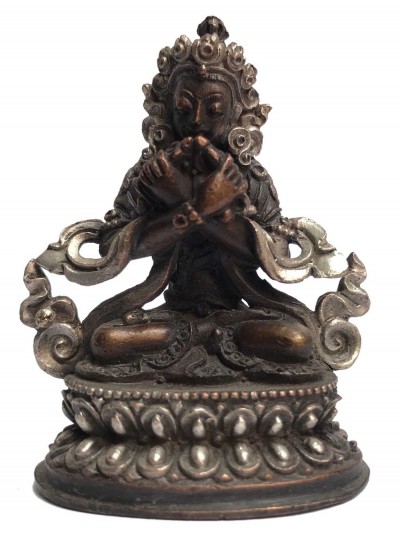
Tibetan Statue OfVajradhara, Double Lotus Base, Silver Plated Oxidized
US$ 11.00
15% off
$ 12.00
$ 12.00

28 cm
Full Metal, Heavy, Master Quality Buddhist Statue Of Vajradhara, Rare Find
US$ 850.00
15% off
$ 1,000.00
$ 1,000.00

20 cm
Buddhist Handmade Statue Of Vajradhara With Consort, Shakti, Yab-Yum, Full Gold Plated, Antique Finishing
US$ 510.00
15% off
$ 600.00
$ 600.00

35 cm
Buddhist Statue Of Vajradhara, Full Gold Plated, Stone Setting, Face Painted
US$ 1,450.00
15% off
$ 1,700.00
$ 1,700.00

36 cm
Master Quality, Buddhist Statue Of Vajradhara, Full Gold Plated, Face Painted
US$ 850.00
15% off
$ 1,000.00
$ 1,000.00

23 cm
High Quality Statue Of Vajradhara With Consort, Shakti, Yab-Yum Bronze Finishing
US$ 340.00
15% off
$ 400.00
$ 400.00

10 cm
Buddhist Statue Of Vajradhara, Full Gold Plated
US$ 110.00
15% off
$ 134.00
$ 134.00

120 cm
Buddhist Handmade Thangka Of Vajradhara With Consort, Shakti, Yab-Yum, Real Gold, Hand Painted, Real Gold
US$ 530.00
15% off
$ 620.00
$ 620.00

33 cm
Buddhist Statue Of Vajradhara, Sand Casting
US$ 160.00
15% off
$ 189.00
$ 189.00

14 cm
Buddhist Handmade Statue Of Vajradhara, Gold Plated, Antique Finishing, HIgh Quality
US$ 240.00
15% off
$ 280.00
$ 280.00
www.handmadeexpo.com
Descriptions
- 1st Karmapa Lama
- 21 Tara
- 4th Zhabdrung Rinpoche
- 5th Karmapa Lama
- Achala
- Agate
- Akash Bhairav
- Akash Yogini
- Akshobhya Buddha
- Amitabha Buddha
- Amoghasiddhi Buddha
- Amoghpasa Lokeshvara
- Anna Purana
- Aparimita
- Ardhanarishvara
- Atisha
- Bagh Bhairav
- BaghChal
- Bal Kumari
- Banglamukhi
- Barahi
- Barhma
- Bhadrakali
- Bhairav
- bhimsen
- Black Jambhala
- Bodhisattva
- Book Cover
- Brahma
- Buddha
- Buddha Gaya
- Chakrasamvara
- Chandamaharoshana
- Chatral Rimponche
- Chenrezig
- cheppu
- Chhinnamasta
- Chintamani
- Citipati
- Cundi
- Dakini
- Damchen Garwai Nakpo
- Dipankara Buddha
- Doll
- Dorje Drolo
- Dorje Legpa
- Dragon
- Durga
- Eight Manifestation of Guru Padmasambhava
- Eight Stupa
- Ekajata
- Fasting Buddha
- Five Dhyani Manjushri
- Five Jambhala
- Flora Incense
- Four Friends
- Four Heavenly Kings
- Gampopa
- Ganesh
- Garuda
- Gesar
- Green Jambhala
- Green Tara
- Guhyasamaja
- Gyaltsab Je tsongkapa
- Hanuman
- Hari Hari Hari Vahana Lokeshvara
- Hayagriva
- Hevajra
- Indra
- Jambhala: namtose
- Jhumkabati Singing Bowl
- Jigmey Lingpa
- Kalachakra
- Kali
- Kamadhenu
- Karmapa
- Khedrup Je Tsongkapa
- Krishna
- ksitigarbha
- Kumari
- Kurukulla
- Lakhe
- Lakshmi
- laughing Buddha
- Longchenpa
- Machig Labdron
- Maha Manjushri
- Maha Vairochana
- Mahakala Black
- Mahakala Black Cloak
- Mahakala Four Arms
- Mahakala Panjaranatha
- Mahakala Six Arms
- Mahakala Twelve Arms
- Mahakala Two Arms
- Mahasiddha
- Maitreya Buddha
- Manakamana
- Mandarava
- Manjushri
- Marici
- Marpa Lotsawa
- Marutse
- Maya Devi
- Medicine Buddha
- Metal Ring
- Milarepa
- Naga Kanya
- Nagaraja
- Nagarjuna Buddha
- Nairatmya Yogini
- Namasangiti
- Namgyalma
- Nandi
- NAROPA
- Nataraj
- Nechung
- Padmapani Lokeshvara
- Padmasambhava
- Palden Lahmo
- Pancha Buddha
- Parvati
- Pehar
- Prajnaparamita
- Radha
- Rahula
- Rama
- Ratnasambhava Buddha
- Real Yak Wool Blanket
- Red Jambhala
- Red Tara
- Sahasrabhuja Avalokitesvara
- Sai baba
- Samantabhadra
- Santoshi Mata
- Saraswati
- Sariputra and Maudgalyayana
- Shakyamuni Buddha
- Sherab Chamma
- shiva
- Siddhi Lakshmi
- Simhamukha Yogini
- Simhanada Lokeshvara
- sita
- Sitatapatra
- Snow lion
- Stupa
- Thangtong Gyalpo
- Three Kayug Masters
- Tilopa
- Tonpa Shenrab
- Tripura Sundari
- Tsongkhapa
- Vairochana Buddha
- Vajradhara
- Vajrakilaya
- Vajrapani
- Vajrasattva
- Vajravarahi
- Vajrayogini
- Vasudhara
- Virupa
- Vishnu
- Wangchok Terwal Drolma
- White Jambhala
- White Mahakala
- White Tara
- Yamantaka
- Yamaraj
- Yellow Jambhala
- Yeshe Tsogyal
- AGNI
- Akshamala
- ANKUSH
- Ashtamangala
- Bana
- Begging Bowl
- Bell
- Bell and Dorje
- Bhuma
- Bhumba
- Bina
- Buddha Eye
- Buddhas Foot Prints
- Buddhist Crown
- Bumpa
- Butter lamp
- Chakra
- chakra Man
- Chamaru
- Chandra
- Chhatra
- Chutor
- Conch shell
- Damaru
- Dathar stand
- Dhanusa
- Dharmachakra
- Dhwoja
- Dipa
- Dorje
- Double Dorje
- Endless knot
- Gada
- Ganesh Skunda
- Ghau
- Incense Burner
- Kalas
- Kamandalu
- Kangling
- Kapala
- Kartika
- Khada
- khadga
- khartwanga
- Lingam
- Lotus
- Mayurpiccha
- Mongoose
- Mukha
- Offering Flower
- OM - Hindu
- OM Mani Padme Hum
- Om-Tibetan
- Owl
- Pa
- Padmasana
- Panas
- Parasol
- Phurba
- Prayer Beads
- Prayer Flags
- Prayer Wheel
- Purna Kalash
- Pustak
- Rudraksha Prayer Beads
- Sang Bur
- Serkyem offering
- Shield
- Singing Bowl
- Sri Yantra
- Surya
- Swastika
- Temple Lion
- The Bodhi Tree
- Three Jewels
- Tingsha
- Trishul
- Tsebum
- Turtle
- Utpala
- Yab Yum
- Yin and yang
- Abhaya Mudra
- Alidh Asana
- Bhumisparsa Mudra
- Dharmchakra Mudra
- Dhayan Asan
- Dhyana Mudra
- Jnana Mudra
- Kurmasana
- Lalit Asana
- Namaskar Mudra
- Nrityamurti Asana
- Paryanka Asana
- Rajalila Asana
- Samapada Asana
- Sayana Asana
- Seven Chakra
- Shakti
- Singa Asan
- Tarjani Mudra
- Vajrahunkar Mudra
- Varda Mudra
- Vitarka Mudra
- Buddha Life Story
- Hundred Jataka Tales
- Kalachakra Mandala
- Karma Gadri Art
- Mandala
- Mantra Mandala
- Navagraha
- Pani Buddha
- Refuge tree
- Refuge Tree Padmasambhava
- Refuge Tree Vajradhara
- Refuse Tree shakyamuni Buddha
- Samadhi
- Secret Accomplishment Hayagriva
- The Four Harmonious Friends
- The way to Heaven
- Three Goddess of Divine Grace
- Three Great Bodhisattvas
- Three Long Life Deities
- Tibetan Calendar
- Wheel of Life
- Acrylic Painting
- Acrylic Wool Shawl
- Agarwood
- Alcohol Serving Set
- Amber
- Amber resin
- Amethyst
- Animal Statue
- Anis Seed
- Aquamarine
- Attar Perfume
- Baba Mask
- Bansuri
- Batik Painting
- Batik Wall Hanging
- Bead Bracelet
- Bead Keyring
- Bead Necklace
- Bead Pendant
- Bed Sheet
- Binayo
- Black Star Sapphire
- Bodhicitta
- Bone Bracelet
- Bone Earring
- Bone Keyring
- Bone Necklace
- Bone Pendant
- Bracelet
- Brooch
- Buddha and Its Tachings
- Candle Stand
- Cashmere Shawl
- Cashmere St Shawl
- Cat House
- cedar
- Celestial Musician
- Chakrasambhara Mandala
- Chau Gong
- Coaster set
- Coin Purse
- Copper Pendant
- Coral
- Cotton Bag
- Cotton Cap
- Cotton Dress
- Cotton Jacket
- Cotton Kurta
- Cotton Poncho
- Cotton Scarf
- Cotton Shawl
- Cotton Short
- Cotton Skirt
- Cotton T-shirt
- Cotton Top
- Cotton Trouser
- Cow
- Crystal
- Dehradun
- Dhaka Poncho
- Dhaka Shawl
- Dhau Pati
- Dhunge Dhara
- Dhyangro
- Door Curtain
- Dreamcatcher
- Ek Tare
- Elephant Candle Stand
- Embroidery Shawl
- Essential Oil
- Felt
- Felt Beads
- Felt Beads Matt
- Felt Necklace
- Flower Urn
- Foldable Table
- Foot Singing Bowls
- Fridge Magnets
- Full Moon Bowl
- Ghungroo
- Glass Bead Bag
- Glass Bead Bangle
- Glass Bead Bracelet
- Glass Bead Earring
- Glass Bead Necklace
- Glass Bead Ring
- Golden Michelia
- Guitar Bag
- Gulpa
- Haldu
- Handmade Sandals
- Head Bowl
- Hemp Bag
- Hemp Belt
- Hemp bracelet
- Hemp Broches
- Hemp Coin Purse
- Hemp Hat
- Hemp Keyring
- Hemp Mat
- Hemp Pendant
- Hemp Shoe
- Hemp Slipper
- Herbal Incense
- Herbal Soap
- HImalayan Coffee
- Hookah
- Incense Holder
- Infinity Scarf
- Jade
- Jamawar Shawl
- Jambati Singing Bowl
- Jasmine
- Jasper
- Jesus
- Jewelery Box
- Jhyamta
- Juniper
- Kamasutra
- Karuwa
- Khadkulo - Kota
- Khainjadi
- khukuri
- Knee Bowl
- Knife
- Kopre Singing Bowls
- kusum Mandala
- Labradorite
- Ladies Bag
- Lapis
- Large Cymbal
- Larimar
- Lavender
- Leather Backpack Bag
- Leather Bag
- Leather Purse
- Leather Shoulder Bag
- Leather Waist Bag
- Lighter Case
- Lingam Singing Bowl
- Lokta Paper Envelop
- Lokta Paper Flip Note book
- Lokta paper Gift Bag
- Lokta Paper Lampshade
- Lokta paper Notebook
- Lokta Paper Packing Box
- Lokta Paper Photo Album
- Lokta Paper Prints
- Lokta Paper Scroll
- Lokta Wrapping Paper
- Lunch Box
- Madal
- Makal Incense Burner
- Malachite
- Mallet
- Mani Singing Bowl
- Manipuri Singing Bowl
- Mantra Amulet
- Mantra Book
- Mantra Cd
- Medical Thangka
- Metal Bracelet
- Metal Earring
- Metal Necklace
- Metal Pendant
- Metal Wall Hangings
- Moonstone
- Murchunga
- Musician Set
- Musk Perfume
- Naga Singing Bowl
- Namaste
- Name Plate
- Nepali Carpet
- Nepali Gong
- Nepali Tea
- Nettle Shawl
- Nipple gong
- Ocean Drum
- Offering Bowls
- Offering Tea
- Oil Painting
- Oni
- Onyx
- Oud Perfume
- Pashmina Blanket
- Pashmina Cardigan
- Pashmina cardigan Size
- Pashmina Muffler
- Pashmina Poncho
- Pashmina Shawl
- Pashmina Sweater
- Pashmina Sweater Sizes
- Pashupatinath
- Patchouli
- Peter Hess Singing Bowl
- Pine Wood
- Playing Cards
- Plumeria
- Prayer wheel Stand
- Ratna Mandala
- Religious Books
- Remuna Singing Bowl
- Rose Quartz
- Sandalwood
- Sang phulpa Incense Burner
- Sarangi
- SB- Trapezoid Singing Bowl
- Seven Chakra Incense
- Shawl Embroidery
- Silver Belt Buckle
- Silver Bet Buckle
- Silver Bracelet
- Silver Decoration Plate
- Silver Earring
- Silver Necklace
- Silver Pendant
- Silver Ring
- silver statue
- Singing bowl Cushion
- Skull
- Snuff bottle
- spieces
- Spoon
- Star Ruby
- Stone Carving
- Student Mandala
- Stupa and Temple
- Stupa Box
- sugar
- Swayambhunath
- Tabla
- Table Cloth
- Tea - Bamboo Box
- Tea - cochin
- Tea - Mandala Bag
- Tea - Paper Box
- Tea - Silver Foil
- Tea - Wooden Box
- Tea Box
- Tea Pot
- Thadobati Singing Bowl
- Thangka Brocade
- Thangka Brocaxc
- Thangka Lhyape
- Tibet Blanket
- Tibet Shawl
- Tibetan Agarwood
- Tibetan Balerian Sugandhawan
- Tibetan Bdellium
- Tibetan Benzoin resin
- Tibetan Book Holder
- Tibetan Calamus
- Tibetan Cedarwood
- Tibetan Cedarwood
- Tibetan Chamomile
- Tibetan Cinnamon
- Tibetan Citronella
- Tibetan Door Curtain
- Tibetan Door Lock
- Tibetan Drangon's Blood
- Tibetan Flower
- Tibetan Frank/Incense
- Tibetan Green Tea
- Tibetan Herbal Mint
- Tibetan Himalayan Spice
- Tibetan Holy Basil
- Tibetan Leamongrass
- Tibetan Mokchhya
- Tibetan Mugwort
- Tibetan Nagchampa
- Tibetan Oraganic instruction
- Tibetan Organic Descrition
- Tibetan Palo Santo
- Tibetan Red Sandalwood
- Tibetan Rose
- Tibetan Rosemary
- Tibetan Saal Doop
- Tibetan Saffron
- Tibetan Sandle Wood
- Tibetan Spikenard
- Tibetan Spiritual Healing
- Tibetan Stamp
- Tibetan urn
- Tibetan White Lotus
- Tibetan White Sage
- Tiger
- Tiger Eye
- Tiger Matt
- Tissue Holder
- Torma
- Tortoise
- Tourmaline
- Tribal Mask
- Tseringma
- Tuberose
- Tungana
- Turquoise
- Ultabati Singing Bowl
- Wall Hanging
- Water Bottle
- Watercolor Painting
- Wild Flora
- Wind gong
- Wooden Door
- Wooden Tibetan Box
- Wooden Traveling Altar
- Woolen set
- Woolen Animal Cap
- Woolen Baby Jacket
- Woolen Cap
- Woolen Carpet
- Woolen Glove
- Woolen Hand warmer
- Woolen Jacket
- Woolen Leg Warmers
- Woolen Muffler
- Woolen Poncho
- Woolen Shock
- Woolen Socks
- Woolen Sweater
- Yajna Puja Set
- Yak Wool Muffler
- Yak Wool Shawl
- Yarchagumba