

Loading Content..

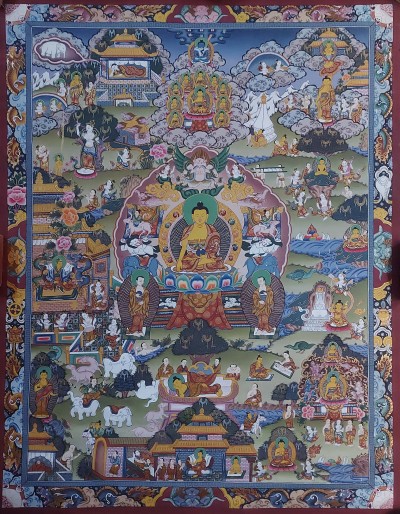
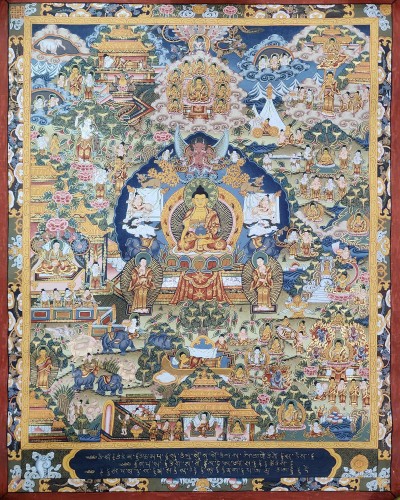
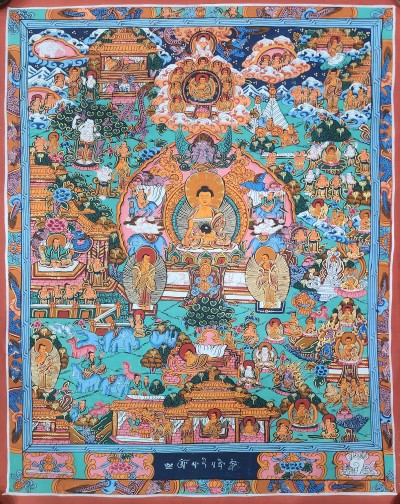
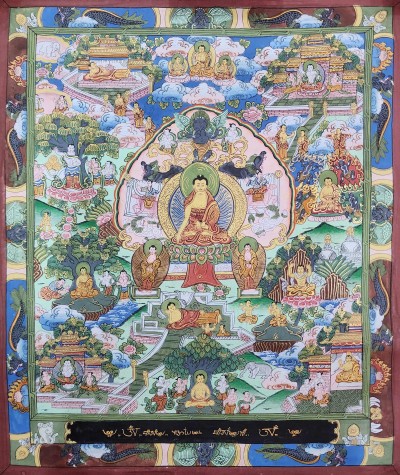
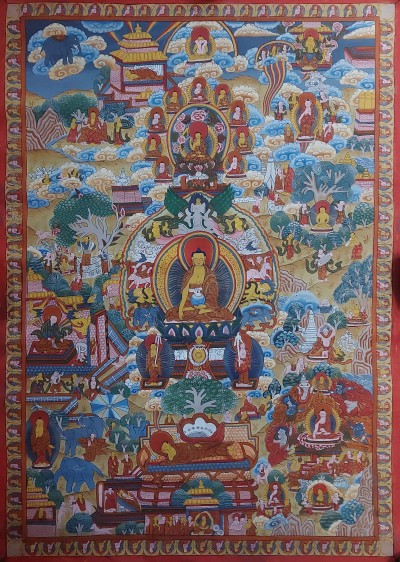
The Life of Buddha
Gautama Buddha, the historical Buddha, lived between 563 and 483 BC in the area known now as the Indo-Nepalese region. As a bodhisattva, he had passed through thousands of existences before coming to Earth for his ultimate transmigration.
This last lifetime he began as a son of the King of the realm Sakya, Sudhodana, who ruled at Kapilavastu, in Ancient India on the border of present-day Nepal, and was born in a village called Lumbini into the warrior tribe called the Sakyas (from where he derived the title Sakyamuni, meaning "Sage of the Sakyas").
According to ancient tradition, Queen Maya, his mother, first had a dream of a beautiful white elephant coming down into her womb, and this was interpreted as a sign that the Buddha, or a universal emperor, was about to be born. When her time came, Queen Maya went into the garden and gave painless birth to the bodhisattva. He immediately walked, spoke, and was received by Brahma.
Five days after his birth, the young prince received the name of Siddhartha. When his parents took him to the temple, the statues of the gods prostrated themselves before him, great were the rejoicings of the people over the birth of this illustrious prince. Also at this time a devout old man named Asita came down from the Himalayas to meet the newborn prince. An ascetic of high spiritual attainments, Asita was particularly pleased to hear this happy news. Having been a tutor to the King, he visited the palace to see the royal baby. The king, who felt honoured by his unexpected visit, carried the child up to him in order to make the child pay him due reverence. To the surprise of all, the child's legs turned and rested on the matted locks of the ascetic.
Instantly, the ascetic rose from his seat and recognizing in the young child the 80 signs that are pledges to a highly religious vocation, and foreseeing with his supernormal vision the child's future greatness, saluted him with clasped hands. The Royal father did likewise. The great ascetic smiled at first and then was sad. Questioned regarding his mingled feelings, he answered that he smiled because the prince would eventually become a Buddha, an Enlightened One, and he was sad because he would not be able to benefit from the superior wisdom of the Enlightened One owing to his prior death and rebirth in a Formless Plane.
After seven days Queen Maya died, and her place as mother was taken by her sister, whose devotion and love became legendary.
When the young prince was in his twelfth year, the king called the wise Brahmans in council. They revealed that Siddhartha would devote himself to asceticism if he cast his eyes on age, sickness, or death ~ and, if he were to meet a hermit.
Wanting his son to be a universal monarch instead, the king surrounded the palace with a triple enclosure and guard and proclaimed that the use of the words death and grief were forbidden. The most beautiful princess in the land, Yasodhara, was found for his bride, and after Siddhartha proved himself in many tournaments calling for strength and prowess, when he was 16, the two were wed.
Siddhartha was kept amused and entertained for some time by this privileged life behind the palace walls until one day his divine vocation awoke in him, and he decided to visit the nearby town. The king called for everything to be swept and decorated, and any ugly or sad sight to be removed. But these precautions were in vain for while Siddhartha was travelling through the streets, an old wrinkled man appeared before him. In astonishment the young prince learned that decrepitude is the fate of those who live life through. Still later he met an incurable invalid and then a funeral procession. Finally heaven placed in his path an ascetic, a beggar, who told Siddhartha that he had left the world to pass beyond suffering and joy, to attain peace at heart.
Confirmed in his meditation, all these experiences awakened in Siddhartha the idea of abandoning his present life and embracing asceticism. He opened his heart to his father and said, "Everything in the world is changing and transitory. Let me go off alone like the religious beggar."
Grief-stricken at the idea of losing his son, the king doubled the guard around the walls and increased the pleasures and distractions within. And at this point, Yasodhara bore him a son whom he called Rahula (meaning "chain" or "fetter"), a name that indicated Gautama's sense of dissatisfaction with his life of luxury, while the birth of his son evoked in him much tenderness. His apparent sense of dissatisfaction turned to disillusion when he saw three things from the window of his palace, each of which represented different forms human suffering: a decrepit old man, a diseased man, and a corpse.Yet even this could not stop the troubling thoughts in his heart or close his eyes to the realizations of the impermanence of all life, and of the vanity and instability of all objects of desire.
His mind made up, he awoke one night and, casting one last look at his wife and child, mounted his horse Kataka and rode off accompanied by his equerry Chandaka. At the city gates Siddhartha turned over his horse to Chandaka, then he cut off his hair, gave up his sumptuous robes, and entered a hermitage where the Brahmans accepted him as a disciple. Siddhartha had now and forever disappeared. He became the monk Gautama, or as he is still called, Sakyamuni, the ascetic of the Sakyas.
For many years Gautama studied the doctrines until, having felt the need to learn more elsewhere, he traveled and fasted. His two teachers had showed him how to reach very deep states of meditation (samadhi). This did not, however, lead to a sense of true knowledge or peace, and the practice of deep meditation was abandoned in favour of a life of extreme asceticism which he shared with five companions. But again, after five or six years of self-mortification, Siddhartha felt he had failed to achieve true insight and rejected such practices as dangerous and useless.
Resolved to continue his quest, Siddharta made his way to a deer park at Isipatana, near present day Benares. Here he sat beneath a tree meditating on death and rebirth. Discovering that excessive fasts destroy strength, he learned that as he had transcended earthly life, so must he next transcend asceticism. Alone and weak, he sat beneath the sacred Bodhi tree of wisdom, and swore to die before arising without the wisdom he sought.
Mara, the demon, fearful of Gautama's power, sent his three beautiful daughters to distract him. When that failed, Mara sent an army of devils to destroy him. Finally Mara attacked Gautama with a terrible weapon capable of cleaving a mountain. But all this was useless, and the motionless monk sat in meditation.
It was here that Siddharta attained a knowledge of the way things really are; it was through this knowledge that he acquired the title Buddha (meaning "awakened one"). This awakening was achieved during a night of meditation, which passed through various stages as the illumination that Gautama had sought slowly welled up in his heart. He knew the exact condition of all beings and the causes of their rebirths. He saw beings live, die and transmigrate. In meditating on human pain, he was enlightened about both its genesis and the means of destroying it.
In this first stage he saw each of his previous existences, and then understood the chain of cause and effect. In the second he surveyed the death and rebirth of all living beings and understood the law that governs the cycle of birth and death. In the third he identified the Four Noble Truths: the universality of suffering, the cause of suffering through selfish desire, the solution to suffering and the way to overcome suffering. This final point is called the Noble Eightfold Path, this being eight steps consisting of wisdom (right views, right intention) ethics (right speech, right action, right livelihood), mental discipline (right effort, right mindfulness, right concentration), which ultimately lead to liberation from the source of suffering.
When day came, Gautama had attained perfect illumination, and had become a Buddha. The rays emanating from his body shone to the boundaries of space. He stayed in meditation for seven more days, and then for four more weeks he stayed by the tree. Through his process of enlightenment he discovered that all sentient beings in this universal life possess buddhahold, and all are future potential buddhas.
From that time he had two alternate paths: he could enter Nirvana immediately, or else he could stay and spread enlightenment. After Brahma came in person to beg him to preach the law, Buddha yielded and stayed on the earth. For many years he traveled and taught his wisdom about the force of love and the destruction of all desire.
Although initially hesitant to share his insight on the grounds that humanity might not be ready for such a teaching, the Buddha decided to communicate his discovery to those willing to listen. His first converts were the five ascetics with whom he had lived when he himself followed the lifestyle of the ascetic. To these he preached his first sermon in the Deer Park at Benares, outlining to them the Four Noble Truths. Out of this small group the community of monks (or Sangha) grew to about 60 in size and came to include Buddha's cousin, Ananda, and his son, Rahula. Later the Buddha was persuaded by his stepmother and cousin to accept women into the sangha.
The remaining 45 years of the Buddha's life were spent journeying around the plain of the Ganges, teaching and receiving visitors.
"There are two extremes which are to be avoided: a life of pleasure ~ this is low and ignoble, unworthy and useless, and runs counter to the affairs of the spirit; and a life of fasting ~ this is sad, unworthy and useless. Perfection has kept its distance from these two extremes, and has found the middle way which leads to repose, knowledge, illumination, and Nirvana. So here is the sacred truth about pain: birth, old age, sickness, death, and separation from that which one loves, are pain. And this is the origin of pain: it is thirst for pleasure, thirst for existence, thirst for impermanence. And here is the truth about the suppression of pain: it is the extinction of that thirst by the destruction of desire.
"Charity, knowledge and virtue are possessions that cannot be lost. To do a little good is worth more than accomplishing works of a difficult nature. The perfect man is nothing unless he pours out kindness on his fellow creatures, unless he consoles the abandoned. My doctrine is a doctrine of mercy. The way of salvation is open to all. Destroy your passions as the elephant would trample down a reed hut. But I would have you know that it is a mistaken idea to believe that one can escape from one's passions by taking shelter in hermitages. The only remedy against evil is healthy reality."
And so Buddha travelled and preached. He performed many miracles, and converted his family and many followers. During his life the Buddha had taught that no one was to succeed him as leader of the Sangha. Instead, his followers were to take his teaching and rule as their sole guides. By the time he reached the age of 80, Sakyamuni began to feel old. He visited all of the monasteries he had founded and prepared to meet his end.
Before the Buddha's death, he became severely sick. He journeyed northwest to the banks of the river Hiranyavati, walking with his disciples, and ate the food offered by a blacksmith. His illness had progresses, and at the end, he came to the river and took a bath. Then he made a rope bed among eight sal trees, with each direction having two. He lay down on his side, right hand supporting his head, the other resting on his body. All later reclining Buddhas (called Buddha's Nirvana) are in the same posture.
The Buddha's disciples kept watch on him after they were told the Buddha was going to nirvana. At night, a scholar of Brahman went to see the Buddha, but was stopped by the Buddha's disciple Ananda. Hearing this, the Buddha called the scholar Subhadda to his bed and spoke him. Thus the scholar became the Buddha's last disciple. The final exhortation of the Buddha to his disciples was that they should not be sorry for losing their tutor. (See the last sermon of the Buddha for
Growing weaker, he spoke one last time: "Do not say we have no master now. The doctrine I have preached will be your master when I have disappeared. Listen, I beg you: ALL CREATIONS ARE IMPERMANENT; work diligently for your liberation."
Having pronounced these final words, Buddha went into the jhana stages, or meditative absorptions. Going from level to level, one after the other, ever deeper and deeper, he reached ecstacy. Then he came out of the meditative absorption for the last time and passed into nirvana, leaving nothing whatever behind that can cause rebirth again in this or any other world.and finally passed into Nirvana.
After his death, Buddha's remains were cremated, as became the Buddhist tradition. The passing away, or the final nirvana, of the Buddha occurred in 483 BC on a full moon day in the month of May, known in the Indian calendar as Wesak.
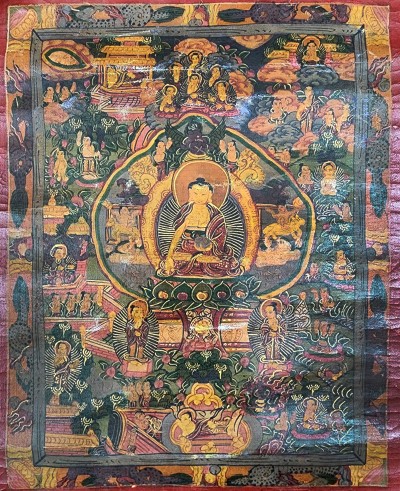
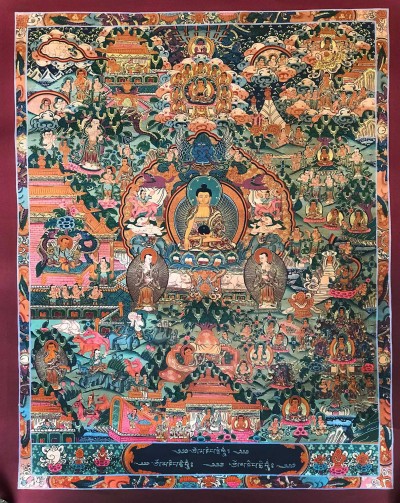
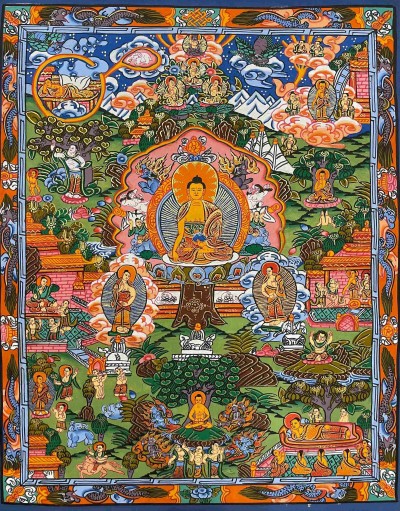
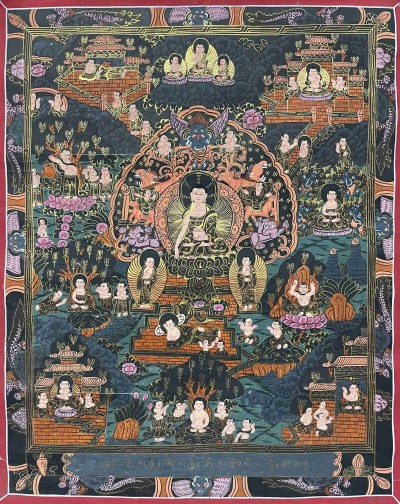
Some Buddha Life Story Available for Purchase

71 cm
Art From Bhaktapur, Buddhist Handmade Thangka Of Buddha Life Story, Hand Painted, Antique, Real Gold
US$ 790.00
25% off
$ 1,053.00
$ 1,053.00

43 cm
Art From Bhaktapur, Buddhist Handmade Thangka Of Buddha Life Story, Hand Painted, Antique, Real Gold
US$ 570.00
25% off
$ 760.00
$ 760.00

100 cm
Buddha Life Story, Buddhist Traditional Painting, Hand Painted, Real Gold
US$ 1,880.00
25% off
$ 2,500.00
$ 2,500.00

51 cm
Buddhist Tibetan Thangka Of Buddha Life Story, Hand Painted
US$ 30.00
25% off
$ 40.00
$ 40.00

31 cm
Art From Bhaktapur, Buddhist Handmade Thangka Of Buddha Life Story, Hand Painted, Antique, Real Gold
US$ 240.00
25% off
$ 325.00
$ 325.00

82 cm
Art From Bhaktapur, Buddhist Handmade Thangka Of Buddha Life Story, Hand Painted, Antique, Real Gold
US$ 650.00
25% off
$ 864.00
$ 864.00

153 cm
Pani Buddha Thanka, RealGold, Tibetan Buddhist Art, Hand Painted, Real Gold
US$ 2,100.00
25% off
$ 2,800.00
$ 2,800.00

109 cm
Buddhist Hand Painting Thangka Of Buddha Life Story With Polyester Brocade, Hand Painted
US$ 68.00
25% off
$ 90.00
$ 90.00

23 cm
Buddhist Tibetan Thangka Of Buddha Life Story, Hand Painted, Antique
US$ 3.00
25% off
$ 4.00
$ 4.00

60 cm
Tibetan Thangka Of Buddha Life Story
US$ 72.00
25% off
$ 96.00
$ 96.00

33 cm
Buddhist Hand Painting Thangka Of Buddha Life Story, Hand Painted
US$ 18.00
25% off
$ 24.00
$ 24.00

43 cm
Buddhist Handmade Thangka Painting Of Buddha Life Story, Real Gold, Hand Painted
US$ 23.00
25% off
$ 30.00
$ 30.00
www.handmadeexpo.com
Descriptions
- 1st Karmapa Lama
- 21 Tara
- 4th Zhabdrung Rinpoche
- 5th Karmapa Lama
- Achala
- Agate
- Akash Bhairav
- Akash Yogini
- Akshobhya Buddha
- Amitabha Buddha
- Amoghasiddhi Buddha
- Amoghpasa Lokeshvara
- Anna Purana
- Aparimita
- Ardhanarishvara
- Atisha
- Bagh Bhairav
- BaghChal
- Bal Kumari
- Banglamukhi
- Barahi
- Barhma
- Bhadrakali
- Bhairav
- bhimsen
- Black Jambhala
- Bodhisattva
- Book Cover
- Brahma
- Buddha
- Buddha Gaya
- Chakrasamvara
- Chandamaharoshana
- Chatral Rimponche
- Chenrezig
- cheppu
- Chhinnamasta
- Chintamani
- Citipati
- Cundi
- Dakini
- Damchen Garwai Nakpo
- Dipankara Buddha
- Doll
- Dorje Drolo
- Dorje Legpa
- Dragon
- Durga
- Eight Manifestation of Guru Padmasambhava
- Eight Stupa
- Ekajata
- Fasting Buddha
- Five Dhyani Manjushri
- Five Jambhala
- Flora Incense
- Four Friends
- Four Heavenly Kings
- Gampopa
- Ganesh
- Garuda
- Gesar
- Green Jambhala
- Green Tara
- Guhyasamaja
- Gyaltsab Je tsongkapa
- Hanuman
- Hari Hari Hari Vahana Lokeshvara
- Hayagriva
- Hevajra
- Indra
- Jambhala: namtose
- Jhumkabati Singing Bowl
- Jigmey Lingpa
- Kalachakra
- Kali
- Kamadhenu
- Karmapa
- Khedrup Je Tsongkapa
- Krishna
- ksitigarbha
- Kumari
- Kurukulla
- Lakhe
- Lakshmi
- laughing Buddha
- Longchenpa
- Machig Labdron
- Maha Manjushri
- Maha Vairochana
- Mahakala Black
- Mahakala Black Cloak
- Mahakala Four Arms
- Mahakala Panjaranatha
- Mahakala Six Arms
- Mahakala Twelve Arms
- Mahakala Two Arms
- Mahasiddha
- Maitreya Buddha
- Manakamana
- Mandarava
- Manjushri
- Marici
- Marpa Lotsawa
- Marutse
- Maya Devi
- Medicine Buddha
- Metal Ring
- Milarepa
- Naga Kanya
- Nagaraja
- Nagarjuna Buddha
- Nairatmya Yogini
- Namasangiti
- Namgyalma
- Nandi
- NAROPA
- Nataraj
- Nechung
- Padmapani Lokeshvara
- Padmasambhava
- Palden Lahmo
- Pancha Buddha
- Parvati
- Pehar
- Prajnaparamita
- Radha
- Rahula
- Rama
- Ratnasambhava Buddha
- Real Yak Wool Blanket
- Red Jambhala
- Red Tara
- Sahasrabhuja Avalokitesvara
- Sai baba
- Samantabhadra
- Santoshi Mata
- Saraswati
- Sariputra and Maudgalyayana
- Shakyamuni Buddha
- Sherab Chamma
- shiva
- Siddhi Lakshmi
- Simhamukha Yogini
- Simhanada Lokeshvara
- sita
- Sitatapatra
- Snow lion
- Stupa
- Thangtong Gyalpo
- Three Kayug Masters
- Tilopa
- Tonpa Shenrab
- Tripura Sundari
- Tsongkhapa
- Vairochana Buddha
- Vajradhara
- Vajrakilaya
- Vajrapani
- Vajrasattva
- Vajravarahi
- Vajrayogini
- Vasudhara
- Virupa
- Vishnu
- Wangchok Terwal Drolma
- White Jambhala
- White Mahakala
- White Tara
- Yamantaka
- Yamaraj
- Yellow Jambhala
- Yeshe Tsogyal
- AGNI
- Akshamala
- ANKUSH
- Ashtamangala
- Bana
- Begging Bowl
- Bell
- Bell and Dorje
- Bhuma
- Bhumba
- Bina
- Buddha Eye
- Buddhas Foot Prints
- Buddhist Crown
- Bumpa
- Butter lamp
- Chakra
- chakra Man
- Chamaru
- Chandra
- Chhatra
- Chutor
- Conch shell
- Damaru
- Dathar stand
- Dhanusa
- Dharmachakra
- Dhwoja
- Dipa
- Dorje
- Double Dorje
- Endless knot
- Gada
- Ganesh Skunda
- Ghau
- Incense Burner
- Kalas
- Kamandalu
- Kangling
- Kapala
- Kartika
- Khada
- khadga
- khartwanga
- Lingam
- Lotus
- Mayurpiccha
- Mongoose
- Mukha
- Offering Flower
- OM - Hindu
- OM Mani Padme Hum
- Om-Tibetan
- Owl
- Pa
- Padmasana
- Panas
- Parasol
- Phurba
- Prayer Beads
- Prayer Flags
- Prayer Wheel
- Purna Kalash
- Pustak
- Rudraksha Prayer Beads
- Sang Bur
- Serkyem offering
- Shield
- Singing Bowl
- Sri Yantra
- Surya
- Swastika
- Temple Lion
- The Bodhi Tree
- Three Jewels
- Tingsha
- Trishul
- Tsebum
- Turtle
- Utpala
- Yab Yum
- Yin and yang
- Abhaya Mudra
- Alidh Asana
- Bhumisparsa Mudra
- Dharmchakra Mudra
- Dhayan Asan
- Dhyana Mudra
- Jnana Mudra
- Kurmasana
- Lalit Asana
- Namaskar Mudra
- Nrityamurti Asana
- Paryanka Asana
- Rajalila Asana
- Samapada Asana
- Sayana Asana
- Seven Chakra
- Shakti
- Singa Asan
- Tarjani Mudra
- Vajrahunkar Mudra
- Varda Mudra
- Vitarka Mudra
- Buddha Life Story
- Hundred Jataka Tales
- Kalachakra Mandala
- Karma Gadri Art
- Mandala
- Mantra Mandala
- Navagraha
- Pani Buddha
- Refuge tree
- Refuge Tree Padmasambhava
- Refuge Tree Vajradhara
- Refuse Tree shakyamuni Buddha
- Samadhi
- Secret Accomplishment Hayagriva
- The Four Harmonious Friends
- The way to Heaven
- Three Goddess of Divine Grace
- Three Great Bodhisattvas
- Three Long Life Deities
- Tibetan Calendar
- Wheel of Life
- Acrylic Painting
- Acrylic Wool Shawl
- Agarwood
- Alcohol Serving Set
- Amber
- Amber resin
- Amethyst
- Animal Statue
- Anis Seed
- Aquamarine
- Attar Perfume
- Baba Mask
- Bansuri
- Batik Painting
- Batik Wall Hanging
- Bead Bracelet
- Bead Keyring
- Bead Necklace
- Bead Pendant
- Bed Sheet
- Binayo
- Black Star Sapphire
- Bodhicitta
- Bone Bracelet
- Bone Earring
- Bone Keyring
- Bone Necklace
- Bone Pendant
- Bracelet
- Brooch
- Buddha and Its Tachings
- Candle Stand
- Cashmere Shawl
- Cashmere St Shawl
- Cat House
- cedar
- Celestial Musician
- Chakrasambhara Mandala
- Chau Gong
- Coaster set
- Coin Purse
- Copper Pendant
- Coral
- Cotton Bag
- Cotton Cap
- Cotton Dress
- Cotton Jacket
- Cotton Kurta
- Cotton Poncho
- Cotton Scarf
- Cotton Shawl
- Cotton Short
- Cotton Skirt
- Cotton T-shirt
- Cotton Top
- Cotton Trouser
- Cow
- Crystal
- Dehradun
- Dhaka Poncho
- Dhaka Shawl
- Dhau Pati
- Dhunge Dhara
- Dhyangro
- Door Curtain
- Dreamcatcher
- Ek Tare
- Elephant Candle Stand
- Embroidery Shawl
- Essential Oil
- Felt
- Felt Beads
- Felt Beads Matt
- Felt Necklace
- Flower Urn
- Foldable Table
- Foot Singing Bowls
- Fridge Magnets
- Full Moon Bowl
- Ghungroo
- Glass Bead Bag
- Glass Bead Bangle
- Glass Bead Bracelet
- Glass Bead Earring
- Glass Bead Necklace
- Glass Bead Ring
- Golden Michelia
- Guitar Bag
- Gulpa
- Haldu
- Handmade Sandals
- Head Bowl
- Hemp Bag
- Hemp Belt
- Hemp bracelet
- Hemp Broches
- Hemp Coin Purse
- Hemp Hat
- Hemp Keyring
- Hemp Mat
- Hemp Pendant
- Hemp Shoe
- Hemp Slipper
- Herbal Incense
- Herbal Soap
- HImalayan Coffee
- Hookah
- Incense Holder
- Infinity Scarf
- Jade
- Jamawar Shawl
- Jambati Singing Bowl
- Jasmine
- Jasper
- Jesus
- Jewelery Box
- Jhyamta
- Juniper
- Kamasutra
- Karuwa
- Khadkulo - Kota
- Khainjadi
- khukuri
- Knee Bowl
- Knife
- Kopre Singing Bowls
- kusum Mandala
- Labradorite
- Ladies Bag
- Lapis
- Large Cymbal
- Larimar
- Lavender
- Leather Backpack Bag
- Leather Bag
- Leather Purse
- Leather Shoulder Bag
- Leather Waist Bag
- Lighter Case
- Lingam Singing Bowl
- Lokta Paper Envelop
- Lokta Paper Flip Note book
- Lokta paper Gift Bag
- Lokta Paper Lampshade
- Lokta paper Notebook
- Lokta Paper Packing Box
- Lokta Paper Photo Album
- Lokta Paper Prints
- Lokta Paper Scroll
- Lokta Wrapping Paper
- Lunch Box
- Madal
- Makal Incense Burner
- Malachite
- Mallet
- Mani Singing Bowl
- Manipuri Singing Bowl
- Mantra Amulet
- Mantra Book
- Mantra Cd
- Medical Thangka
- Metal Bracelet
- Metal Earring
- Metal Necklace
- Metal Pendant
- Metal Wall Hangings
- Moonstone
- Murchunga
- Musician Set
- Musk Perfume
- Naga Singing Bowl
- Namaste
- Name Plate
- Nepali Carpet
- Nepali Gong
- Nepali Tea
- Nettle Shawl
- Nipple gong
- Ocean Drum
- Offering Bowls
- Offering Tea
- Oil Painting
- Oni
- Onyx
- Oud Perfume
- Pashmina Blanket
- Pashmina Cardigan
- Pashmina cardigan Size
- Pashmina Muffler
- Pashmina Poncho
- Pashmina Shawl
- Pashmina Sweater
- Pashmina Sweater Sizes
- Pashupatinath
- Patchouli
- Peter Hess Singing Bowl
- Pine Wood
- Playing Cards
- Plumeria
- Prayer wheel Stand
- Ratna Mandala
- Religious Books
- Remuna Singing Bowl
- Rose Quartz
- Sandalwood
- Sang phulpa Incense Burner
- Sarangi
- SB- Trapezoid Singing Bowl
- Seven Chakra Incense
- Shawl Embroidery
- Silver Belt Buckle
- Silver Bet Buckle
- Silver Bracelet
- Silver Decoration Plate
- Silver Earring
- Silver Necklace
- Silver Pendant
- Silver Ring
- silver statue
- Singing bowl Cushion
- Skull
- Snuff bottle
- spieces
- Spoon
- Star Ruby
- Stone Carving
- Student Mandala
- Stupa and Temple
- Stupa Box
- sugar
- Swayambhunath
- Tabla
- Table Cloth
- Tea - Bamboo Box
- Tea - cochin
- Tea - Mandala Bag
- Tea - Paper Box
- Tea - Silver Foil
- Tea - Wooden Box
- Tea Box
- Tea Pot
- Thadobati Singing Bowl
- Thangka Brocade
- Thangka Brocaxc
- Thangka Lhyape
- Tibet Blanket
- Tibet Shawl
- Tibetan Agarwood
- Tibetan Balerian Sugandhawan
- Tibetan Bdellium
- Tibetan Benzoin resin
- Tibetan Book Holder
- Tibetan Calamus
- Tibetan Cedarwood
- Tibetan Cedarwood
- Tibetan Chamomile
- Tibetan Cinnamon
- Tibetan Citronella
- Tibetan Door Curtain
- Tibetan Door Lock
- Tibetan Drangon's Blood
- Tibetan Flower
- Tibetan Frank/Incense
- Tibetan Green Tea
- Tibetan Herbal Mint
- Tibetan Himalayan Spice
- Tibetan Holy Basil
- Tibetan Leamongrass
- Tibetan Mokchhya
- Tibetan Mugwort
- Tibetan Nagchampa
- Tibetan Oraganic instruction
- Tibetan Organic Descrition
- Tibetan Palo Santo
- Tibetan Red Sandalwood
- Tibetan Rose
- Tibetan Rosemary
- Tibetan Saal Doop
- Tibetan Saffron
- Tibetan Sandle Wood
- Tibetan Spikenard
- Tibetan Spiritual Healing
- Tibetan Stamp
- Tibetan urn
- Tibetan White Lotus
- Tibetan White Sage
- Tiger
- Tiger Eye
- Tiger Matt
- Tissue Holder
- Torma
- Tortoise
- Tourmaline
- Tribal Mask
- Tseringma
- Tuberose
- Tungana
- Turquoise
- Ultabati Singing Bowl
- Wall Hanging
- Water Bottle
- Watercolor Painting
- Wild Flora
- Wind gong
- Wooden Door
- Wooden Tibetan Box
- Wooden Traveling Altar
- Woolen set
- Woolen Animal Cap
- Woolen Baby Jacket
- Woolen Cap
- Woolen Carpet
- Woolen Glove
- Woolen Hand warmer
- Woolen Jacket
- Woolen Leg Warmers
- Woolen Muffler
- Woolen Poncho
- Woolen Shock
- Woolen Socks
- Woolen Sweater
- Yajna Puja Set
- Yak Wool Muffler
- Yak Wool Shawl
- Yarchagumba