

Loading Content..

The ancient Sanskrit term 'Buddha' translates to 'awakened' or 'supreme awareness', closely linked with 'Bodhi' denoting enlightenment. Gautama Shakyamuni, born around 563 BCE in Lumbini (now Nepal), epitomizes compassionate understanding and enlightened consciousness. His teachings centered on understanding desire's role in perpetuating suffering, a theme resonating across Hinduism, Jainism, and related faiths. He emphasized how greed, selfishness, and possessiveness obscure higher awareness, perpetuating suffering among the sick, hungry, elderly, and impoverished. Gautama's serene image stands in contrast to Western ideals of materialism and outward pride, advocating for inner enlightenment as the path to alleviating worldly suffering.
The idea of freeing the self (ourselves) from material world & the realisation of the supreme self is a theme common to Indian Philosophy. This is why word associated with the liberation such as Moksha, Samsara ( cycles of suffering), Karma & Nirvana are common to Hinduism , Jainism & Sikhism. The difference between these three schools of thought is twofold, 1. How this freeing of the self is attained & 2. What the nature of this freedom 'is'. That is what state of being freed or partly freed actually feels like or how it can be described.
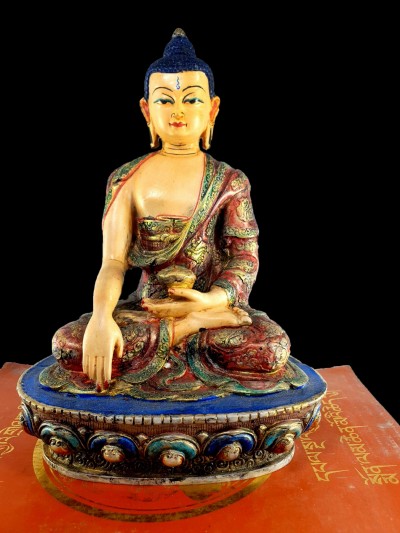
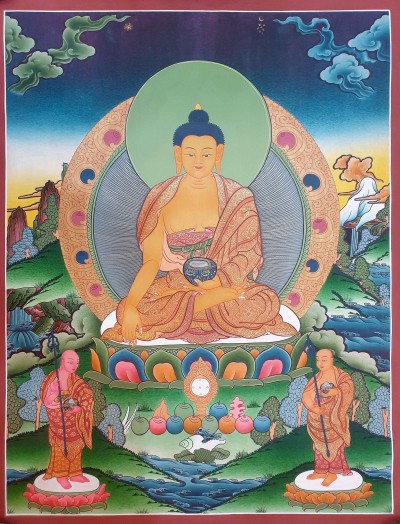
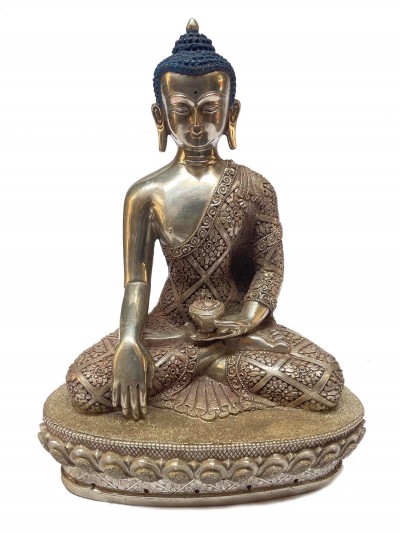
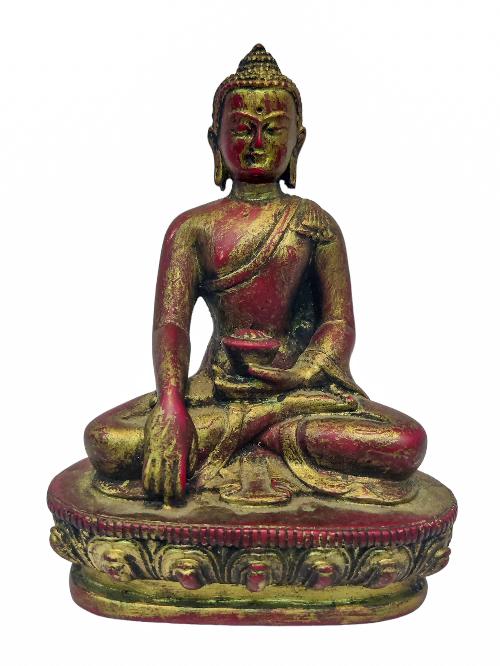
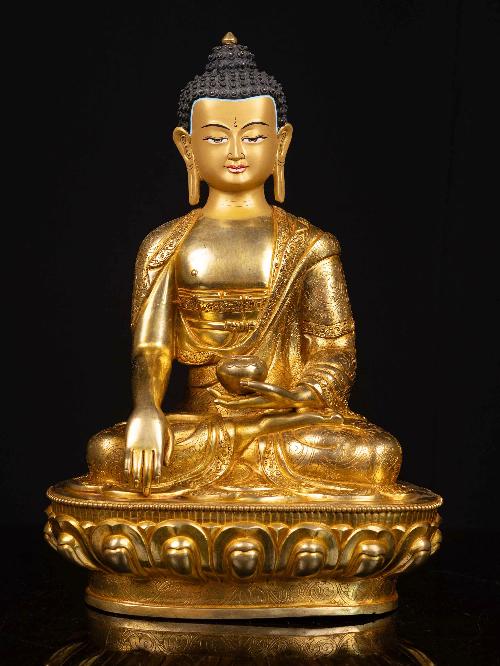
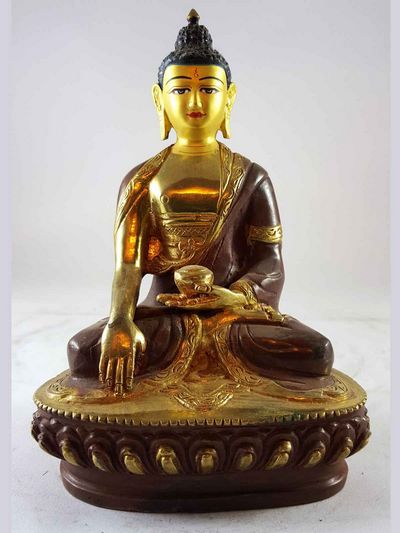
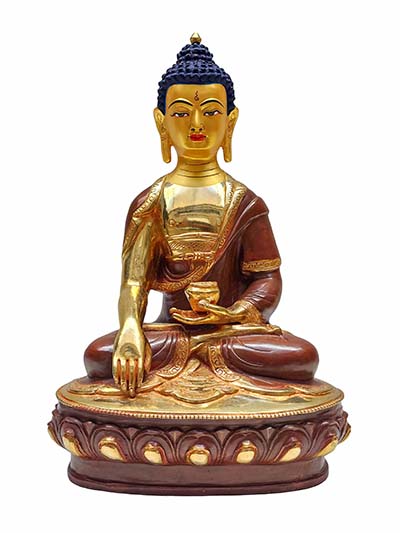
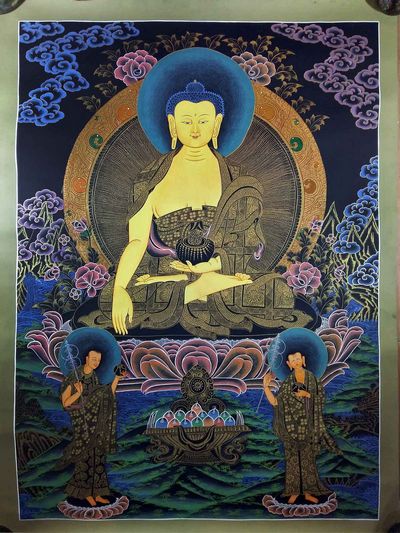
Gautama is painted with golden skin sitting in a lotus seat [Skt. Padmasana] also called the meditative seat [Skt. Dhyanasana] & upon a white moon disc which represents the male principle of method which itself is upon a lotus throne. His left hand touches the ground in what is called bhumisparse mudra which symbolises his own recognition of enlightened mind in one of the most iconic images in all Buddhism. The palm always faces inwards. His feet are deliberately drawn level with one another & enlarged, being specific marks of a Buddha. His right hand supports an alms bowl [Skt. Patra], containing the liquid elixir of eternal life. Somehow the simple image of the bowl reflects his overwhelming humility & kindness. He wears the traditionally maroon gold monk's patched robe [Skt. Samghati] made of twenty five pieces of cloth which the first Buddhist monks sewed together. The Buddha has a green nimbus and blue aureole around his body signifying the highest level of understanding. Siddhartha is surrounded by Pink Lotuses [Skt. Padma]. This kind of lotus is connected with loving kindness & a flowering of pure consciousness. The closed bud to his right side represents the past or originating mind, the blooming flower represents the present & the buds represents the future Buddha Maitreya and forthcoming realisations. His elongated earlobes depict his royal connection; his knotted black hair & topknot symbolise his abandonment of worldly possessions; the dot [Skt. Urna] on his brow on the command chakra [Skt. Ajna] represents his transcendent wisdom, the 31st mark of a Buddha.
Life Story
Gautama was born c.563 BCE Lumbini, today in Nepal Died c.483 BCE Kushinagar in India. within the Sakya kingdom in Nepal. He family names were variously called Gautama [Skt. 'Best Cow'] & surname Shakyamuni [Skt. meaning 'Sage of the Shakyas'] The name Gautama is linked with a person called Maharshi [Eng. victorious on earth] Gautama who was an ancient seer. Maharshi Gouthama descendents adopted his surname. During his life he was as often called Gautama Tathagata, as Gautama Siddhi-hatha as Gautama Buddha. It was in recognition of his spiritual accomplishments he was called Siddhartha & relates to why Gautama is a Hindu avatar. The lineage of 23 Buddhas were for the majority drawn from Janapada Kings & high ranking Brahmins.
He studied Buddhist Ideas in several locations in Kashmir & Northern India which to may seem a contradiction in terms, this is because to many Gautama Buddha is what Buddhism is. There are in fact two basic schools of thought. 1. That Gautama is recognised for his enlightened reasoning who according to Theravada Buddhism was the 28th Buddha. 2. That he is the Supreme Buddha [Skt. Sammasambuddha] of our age & that he is the be all & end all of Buddhist Doctrine, & closely follow his progress or 'life story' & to how he in how became full awoken. In Hinduism he is considered to be the ninth avatar of God Vishnu.
At the age of 29 Siddhartha left his palace in order to meet his people. Despite his father's effort to remove the sick, aged & impoverished, Siddhartha encountered an old man. Disturbed by this, when told that all people would eventually grow old by his charioteer Channa, variously, a diseased man, a decaying corpse, and an ascetic. Deeply depressed by these sights, he sought to overcome old age, illness, and death by living the life of an ascetic. He left his palace leaving behind this royal life to become a mendicant. Siddhartha left Rajagaha and practised under two hermit teachers. After mastering the teachings of Alara Kalama Siddhartha was asked by Kalama to succeed him, but moved on.
He then became a student of Uddaka Ramaputta, but although he achieved high levels of meditative consciousness and was asked to succeed Ramaputta, he was still not satisfied with his path, and moved on. He initially became as ascetic but then After asceticism and concentrating on meditation and Anapana-sati (awareness of breathing in and out), Siddhartha is said to have discovered what Buddhists call the Middle Way- a path of moderation away from the extremes of self-indulgence and self-mortification.
Gautama thus journeyed to Deer Park near Varanasi (Benares) in northern India, he set in motion the Wheel of Dharma by delivering his first sermon to the group of five companions with whom he had previously sought enlightenment. They, together with the Buddha, formed the first sangha, the company of Buddhist monks. For the remaining 45 years of his life, the Buddha is said to have traveled in the Gangetic Plain, in what is now Uttar Pradesh, Bihar & southern Nepal, teaching to an extremely diverse range of people, from nobles to outcaste street sweepers, mass murderers such as Angulimala & cannibals such as Alavaka. The sangha travelled from place to place in India, expounding the dharma.
2nd Commentary Gautama's entire Teachings revolve around: The Principle of the Three marks of existence; 1. Dukkha (Sanskrit: du?kha): That all beings suffer from all situations due to unclear mind. 2. Anicca (Sanskrit: anitya): That all things are impermanent. 3. Anatta (Sanskrit: anatman): That the perception of a constant "self" is an illusion. Gautama considers the arising of this suffering, & explains that this is caused by a misunderstanding of phenomena (the world around us) which is impermanent [Anicca] which he then related to the illusion of the ego, which is actually nothing but an illusion. [Anatta]. He shows that by understanding the nature of the suffering, & specifically its arising, we can alleviate this or extinguish it altogether.
Commentary
The Principle of the Four Noble Truths: that suffering is an inherent part of existence; that the origin of suffering is ignorance and the main symptoms of that ignorance are attachment and craving; that attachment and craving can be ceased.
1.To live means to suffer, because the human nature is not perfect and neither is the world we live in. During our lifetime, we inevitably have to endure physical suffering such as pain, sickness, injury, tiredness, old age, and eventually death; and we have to endure psychological suffering like sadness, fear, frustration, disappointment, and depression. Although there are different degrees of suffering and there are also positive experiences in life that we perceive as the opposite of suffering, such as ease, comfort and happiness, life in its totality is imperfect and incomplete, because our world is subject to impermanence. This means we are never able to keep permanently what we strive for, and just as happy moments pass by, we ourselves and our loved ones will pass away one day, too.
2. The origin of suffering is attachment. The origin of suffering is attachment to transient things and the ignorance thereof. Transient things do not only include the physical objects that surround us, but also ideas, and -in a greater sense- all objects of our perception. Ignorance is the lack of understanding of how our mind is attached to impermanent things. The reasons for suffering are desire, passion, ardour, pursuit of wealth and prestige, striving for fame and popularity, or in short: craving and clinging. Because the objects of our attachment are transient, their loss is inevitable, thus suffering will necessarily follow. Objects of attachment also include the idea of a "self" which is a delusion, because there is no abiding self. What we call "self" is just an imagined entity, and we are merely a part of the ceaseless becoming of the universe.
3. The cessation of suffering is attainable. The cessation of suffering can be attained through nirodha. Nirodha means the unmaking of sensual craving and conceptual attachment. The third noble truth expresses the idea that suffering can be ended by attaining dispassion. Nirodha extinguishes all forms of clinging and attachment. This means that suffering can be overcome through human activity, simply by removing the cause of suffering. Attaining and perfecting dispassion is a process of many levels that ultimately results in the state of Nirvana. Nirvana means freedom from all worries, troubles, complexes, fabrications and ideas. Nirvana is not comprehensible for those who have not attained it.
4. The path to the cessation of suffering. There is a path to the end of suffering - a gradual path of self-improvement, which is described more detailed in the Eightfold Path. It is the middle way between the two extremes of excessive self-indulgence (hedonism) and excessive self-mortification (asceticism); and it leads to the end of the cycle of rebirth. The latter quality discerns it from other paths which are merely "wandering on the wheel of becoming", because these do not have a final object. The path to the end of suffering can extend over many lifetimes, throughout which every individual rebirth is subject to karmic conditioning. Craving, ignorance, delusions, and its effects will disappear gradually, as progress is made on the Noble Eightfold Path will lead to the cessation of attachment and craving and therefore suffering.
Mantra of Shakyamuni buddha
Om Muni Muni Maha Muniye Soha
Some Shakyamuni Buddha Available for Purchase

20 cm
Resin Statue Of Shakyamuni Buddha Traditional Color Painted, White And Blue
US$ 32.00
25% off
$ 42.00
$ 42.00

60 cm
Thangka Painting Of Shakyamuni Buddha, Real Gold
US$ 150.00
25% off
$ 200.00
$ 200.00

22 cm
Master Quality, Sterling Silver, 1702 Gram Statue Of Shakyamuni Buddha, Old Stock
US$ 4,730.00
25% off
$ 6,300.00
$ 6,300.00

14 cm
Shakyamuni Buddha, Buddhist Statue, resin Mold
US$ 15.00
25% off
$ 20.00
$ 20.00

32 cm
Shakyamuni Buddha, Buddhist Handmade Statue, Full Gold Plated, Face Painted
US$ 1,080.00
25% off
$ 1,440.00
$ 1,440.00

15 cm
Best Price, Statue Of Shakyamuni Buddha Partly Gold Plated, Painted Face, For A Gift, Altars And Buddhist Ritual
US$ 75.00
25% off
$ 100.00
$ 100.00

33 cm
Shakyamuni Buddha, Buddhist Handmade Statue With Extra Gold On Base, Partly Gold Plated, Face Painted
US$ 160.00
25% off
$ 210.00
$ 210.00

31 cm
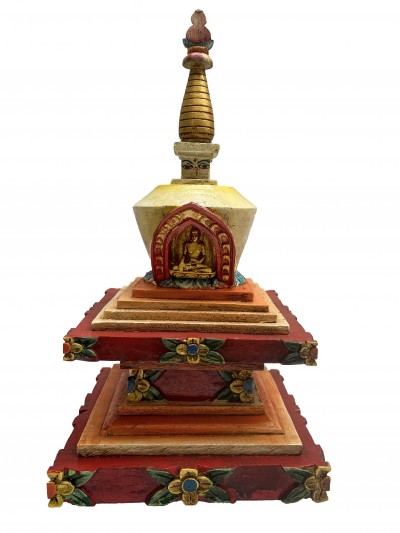
Buddhist Wooden Statue Of Stupa, With Shakyamuni Buddha, Traditional Color Finishing
US$ 45.00
25% off
$ 60.00
$ 60.00

21 cm
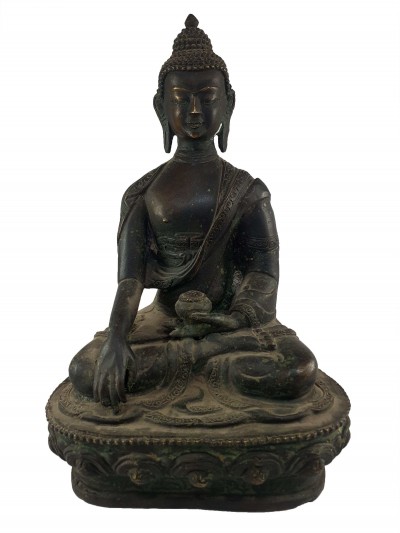
Buddhist Statue Of Shakyamuni Buddha Antique
US$ 230.00
25% off
$ 300.00
$ 300.00

23 cm
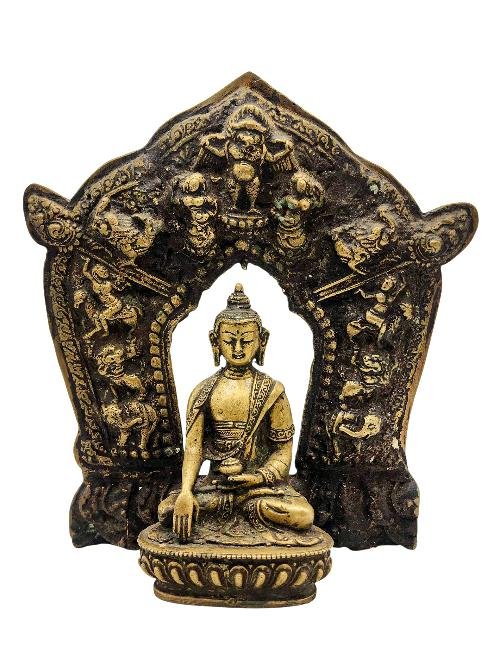
Shakyamuni Buddha With Various God, Buddhist Handmade Statue, Antique Finishing
US$ 250.00
25% off
$ 330.00
$ 330.00

65 cm
Shakyamuni Buddha Thangka With Sariputra And Madugalyan
US$ 90.00
25% off
$ 120.00
$ 120.00

19 cm
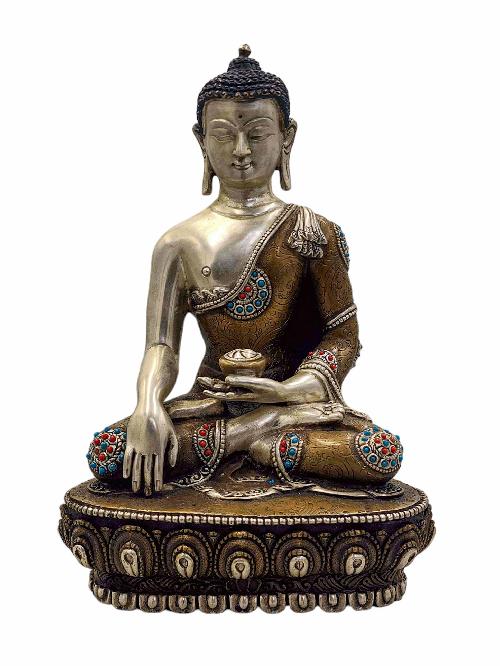
Shakyamuni Buddha, Buddhist Handmade Statue, Silver Oxidized, Stone Setting, High Quality
US$ 470.00
25% off
$ 625.00
$ 625.00
www.handmadeexpo.com
Descriptions
- 1st Karmapa Lama
- 21 Tara
- 4th Zhabdrung Rinpoche
- 5th Karmapa Lama
- Achala
- Agate
- Akash Bhairav
- Akash Yogini
- Akshobhya Buddha
- Amitabha Buddha
- Amoghasiddhi Buddha
- Amoghpasa Lokeshvara
- Anna Purana
- Aparimita
- Ardhanarishvara
- Atisha
- Bagh Bhairav
- BaghChal
- Bal Kumari
- Banglamukhi
- Barahi
- Barhma
- Bhadrakali
- Bhairav
- bhimsen
- Black Jambhala
- Bodhisattva
- Book Cover
- Brahma
- Buddha
- Buddha Gaya
- Chakrasamvara
- Chandamaharoshana
- Chatral Rimponche
- Chenrezig
- cheppu
- Chhinnamasta
- Chintamani
- Citipati
- Cundi
- Dakini
- Damchen Garwai Nakpo
- Dipankara Buddha
- Doll
- Dorje Drolo
- Dorje Legpa
- Dragon
- Durga
- Eight Manifestation of Guru Padmasambhava
- Eight Stupa
- Ekajata
- Fasting Buddha
- Five Dhyani Manjushri
- Five Jambhala
- Flora Incense
- Four Friends
- Four Heavenly Kings
- Gampopa
- Ganesh
- Garuda
- Gesar
- Green Jambhala
- Green Tara
- Guhyasamaja
- Gyaltsab Je tsongkapa
- Hanuman
- Hari Hari Hari Vahana Lokeshvara
- Hayagriva
- Hevajra
- Indra
- Jambhala: namtose
- Jhumkabati Singing Bowl
- Jigmey Lingpa
- Kalachakra
- Kali
- Kamadhenu
- Karmapa
- Khedrup Je Tsongkapa
- Krishna
- ksitigarbha
- Kumari
- Kurukulla
- Lakhe
- Lakshmi
- laughing Buddha
- Longchenpa
- Machig Labdron
- Maha Manjushri
- Maha Vairochana
- Mahakala Black
- Mahakala Black Cloak
- Mahakala Four Arms
- Mahakala Panjaranatha
- Mahakala Six Arms
- Mahakala Twelve Arms
- Mahakala Two Arms
- Mahasiddha
- Maitreya Buddha
- Manakamana
- Mandarava
- Manjushri
- Marici
- Marpa Lotsawa
- Marutse
- Maya Devi
- Medicine Buddha
- Metal Ring
- Milarepa
- Naga Kanya
- Nagaraja
- Nagarjuna Buddha
- Nairatmya Yogini
- Namasangiti
- Namgyalma
- Nandi
- NAROPA
- Nataraj
- Nechung
- Padmapani Lokeshvara
- Padmasambhava
- Palden Lahmo
- Pancha Buddha
- Parvati
- Pehar
- Prajnaparamita
- Radha
- Rahula
- Rama
- Ratnasambhava Buddha
- Real Yak Wool Blanket
- Red Jambhala
- Red Tara
- Sahasrabhuja Avalokitesvara
- Sai baba
- Samantabhadra
- Santoshi Mata
- Saraswati
- Sariputra and Maudgalyayana
- Shakyamuni Buddha
- Sherab Chamma
- shiva
- Siddhi Lakshmi
- Simhamukha Yogini
- Simhanada Lokeshvara
- sita
- Sitatapatra
- Snow lion
- Stupa
- Thangtong Gyalpo
- Three Kayug Masters
- Tilopa
- Tonpa Shenrab
- Tripura Sundari
- Tsongkhapa
- Vairochana Buddha
- Vajradhara
- Vajrakilaya
- Vajrapani
- Vajrasattva
- Vajravarahi
- Vajrayogini
- Vasudhara
- Virupa
- Vishnu
- Wangchok Terwal Drolma
- White Jambhala
- White Mahakala
- White Tara
- Yamantaka
- Yamaraj
- Yellow Jambhala
- Yeshe Tsogyal
- AGNI
- Akshamala
- ANKUSH
- Ashtamangala
- Bana
- Begging Bowl
- Bell
- Bell and Dorje
- Bhuma
- Bhumba
- Bina
- Buddha Eye
- Buddhas Foot Prints
- Buddhist Crown
- Bumpa
- Butter lamp
- Chakra
- chakra Man
- Chamaru
- Chandra
- Chhatra
- Chutor
- Conch shell
- Damaru
- Dathar stand
- Dhanusa
- Dharmachakra
- Dhwoja
- Dipa
- Dorje
- Double Dorje
- Endless knot
- Gada
- Ganesh Skunda
- Ghau
- Incense Burner
- Kalas
- Kamandalu
- Kangling
- Kapala
- Kartika
- Khada
- khadga
- khartwanga
- Lingam
- Lotus
- Mayurpiccha
- Mongoose
- Mukha
- Offering Flower
- OM - Hindu
- OM Mani Padme Hum
- Om-Tibetan
- Owl
- Pa
- Padmasana
- Panas
- Parasol
- Phurba
- Prayer Beads
- Prayer Flags
- Prayer Wheel
- Purna Kalash
- Pustak
- Rudraksha Prayer Beads
- Sang Bur
- Serkyem offering
- Shield
- Singing Bowl
- Sri Yantra
- Surya
- Swastika
- Temple Lion
- The Bodhi Tree
- Three Jewels
- Tingsha
- Trishul
- Tsebum
- Turtle
- Utpala
- Yab Yum
- Yin and yang
- Abhaya Mudra
- Alidh Asana
- Bhumisparsa Mudra
- Dharmchakra Mudra
- Dhayan Asan
- Dhyana Mudra
- Jnana Mudra
- Kurmasana
- Lalit Asana
- Namaskar Mudra
- Nrityamurti Asana
- Paryanka Asana
- Rajalila Asana
- Samapada Asana
- Sayana Asana
- Seven Chakra
- Shakti
- Singa Asan
- Tarjani Mudra
- Vajrahunkar Mudra
- Varda Mudra
- Vitarka Mudra
- Buddha Life Story
- Hundred Jataka Tales
- Kalachakra Mandala
- Karma Gadri Art
- Mandala
- Mantra Mandala
- Navagraha
- Pani Buddha
- Refuge tree
- Refuge Tree Padmasambhava
- Refuge Tree Vajradhara
- Refuse Tree shakyamuni Buddha
- Samadhi
- Secret Accomplishment Hayagriva
- The Four Harmonious Friends
- The way to Heaven
- Three Goddess of Divine Grace
- Three Great Bodhisattvas
- Three Long Life Deities
- Tibetan Calendar
- Wheel of Life
- Acrylic Painting
- Acrylic Wool Shawl
- Agarwood
- Alcohol Serving Set
- Amber
- Amber resin
- Amethyst
- Animal Statue
- Anis Seed
- Aquamarine
- Attar Perfume
- Baba Mask
- Bansuri
- Batik Painting
- Batik Wall Hanging
- Bead Bracelet
- Bead Keyring
- Bead Necklace
- Bead Pendant
- Bed Sheet
- Binayo
- Black Star Sapphire
- Bodhicitta
- Bone Bracelet
- Bone Earring
- Bone Keyring
- Bone Necklace
- Bone Pendant
- Bracelet
- Brooch
- Buddha and Its Tachings
- Candle Stand
- Cashmere Shawl
- Cashmere St Shawl
- Cat House
- cedar
- Celestial Musician
- Chakrasambhara Mandala
- Chau Gong
- Coaster set
- Coin Purse
- Copper Pendant
- Coral
- Cotton Bag
- Cotton Cap
- Cotton Dress
- Cotton Jacket
- Cotton Kurta
- Cotton Poncho
- Cotton Scarf
- Cotton Shawl
- Cotton Short
- Cotton Skirt
- Cotton T-shirt
- Cotton Top
- Cotton Trouser
- Cow
- Crystal
- Dehradun
- Dhaka Poncho
- Dhaka Shawl
- Dhau Pati
- Dhunge Dhara
- Dhyangro
- Door Curtain
- Dreamcatcher
- Ek Tare
- Elephant Candle Stand
- Embroidery Shawl
- Essential Oil
- Felt
- Felt Beads
- Felt Beads Matt
- Felt Necklace
- Flower Urn
- Foldable Table
- Foot Singing Bowls
- Fridge Magnets
- Full Moon Bowl
- Ghungroo
- Glass Bead Bag
- Glass Bead Bangle
- Glass Bead Bracelet
- Glass Bead Earring
- Glass Bead Necklace
- Glass Bead Ring
- Golden Michelia
- Guitar Bag
- Gulpa
- Haldu
- Handmade Sandals
- Head Bowl
- Hemp Bag
- Hemp Belt
- Hemp bracelet
- Hemp Broches
- Hemp Coin Purse
- Hemp Hat
- Hemp Keyring
- Hemp Mat
- Hemp Pendant
- Hemp Shoe
- Hemp Slipper
- Herbal Incense
- Herbal Soap
- HImalayan Coffee
- Hookah
- Incense Holder
- Infinity Scarf
- Jade
- Jamawar Shawl
- Jambati Singing Bowl
- Jasmine
- Jasper
- Jesus
- Jewelery Box
- Jhyamta
- Juniper
- Kamasutra
- Karuwa
- Khadkulo - Kota
- Khainjadi
- khukuri
- Knee Bowl
- Knife
- Kopre Singing Bowls
- kusum Mandala
- Labradorite
- Ladies Bag
- Lapis
- Large Cymbal
- Larimar
- Lavender
- Leather Backpack Bag
- Leather Bag
- Leather Purse
- Leather Shoulder Bag
- Leather Waist Bag
- Lighter Case
- Lingam Singing Bowl
- Lokta Paper Envelop
- Lokta Paper Flip Note book
- Lokta paper Gift Bag
- Lokta Paper Lampshade
- Lokta paper Notebook
- Lokta Paper Packing Box
- Lokta Paper Photo Album
- Lokta Paper Prints
- Lokta Paper Scroll
- Lokta Wrapping Paper
- Lunch Box
- Madal
- Makal Incense Burner
- Malachite
- Mallet
- Mani Singing Bowl
- Manipuri Singing Bowl
- Mantra Amulet
- Mantra Book
- Mantra Cd
- Medical Thangka
- Metal Bracelet
- Metal Earring
- Metal Necklace
- Metal Pendant
- Metal Wall Hangings
- Moonstone
- Murchunga
- Musician Set
- Musk Perfume
- Naga Singing Bowl
- Namaste
- Name Plate
- Nepali Carpet
- Nepali Gong
- Nepali Tea
- Nettle Shawl
- Nipple gong
- Ocean Drum
- Offering Bowls
- Offering Tea
- Oil Painting
- Oni
- Onyx
- Oud Perfume
- Pashmina Blanket
- Pashmina Cardigan
- Pashmina cardigan Size
- Pashmina Muffler
- Pashmina Poncho
- Pashmina Shawl
- Pashmina Sweater
- Pashmina Sweater Sizes
- Pashupatinath
- Patchouli
- Peter Hess Singing Bowl
- Pine Wood
- Playing Cards
- Plumeria
- Prayer wheel Stand
- Ratna Mandala
- Religious Books
- Remuna Singing Bowl
- Rose Quartz
- Sandalwood
- Sang phulpa Incense Burner
- Sarangi
- SB- Trapezoid Singing Bowl
- Seven Chakra Incense
- Shawl Embroidery
- Silver Belt Buckle
- Silver Bet Buckle
- Silver Bracelet
- Silver Decoration Plate
- Silver Earring
- Silver Necklace
- Silver Pendant
- Silver Ring
- silver statue
- Singing bowl Cushion
- Skull
- Snuff bottle
- spieces
- Spoon
- Star Ruby
- Stone Carving
- Student Mandala
- Stupa and Temple
- Stupa Box
- sugar
- Swayambhunath
- Tabla
- Table Cloth
- Tea - Bamboo Box
- Tea - cochin
- Tea - Mandala Bag
- Tea - Paper Box
- Tea - Silver Foil
- Tea - Wooden Box
- Tea Box
- Tea Pot
- Thadobati Singing Bowl
- Thangka Brocade
- Thangka Brocaxc
- Thangka Lhyape
- Tibet Blanket
- Tibet Shawl
- Tibetan Agarwood
- Tibetan Balerian Sugandhawan
- Tibetan Bdellium
- Tibetan Benzoin resin
- Tibetan Book Holder
- Tibetan Calamus
- Tibetan Cedarwood
- Tibetan Cedarwood
- Tibetan Chamomile
- Tibetan Cinnamon
- Tibetan Citronella
- Tibetan Door Curtain
- Tibetan Door Lock
- Tibetan Drangon's Blood
- Tibetan Flower
- Tibetan Frank/Incense
- Tibetan Green Tea
- Tibetan Herbal Mint
- Tibetan Himalayan Spice
- Tibetan Holy Basil
- Tibetan Leamongrass
- Tibetan Mokchhya
- Tibetan Mugwort
- Tibetan Nagchampa
- Tibetan Oraganic instruction
- Tibetan Organic Descrition
- Tibetan Palo Santo
- Tibetan Red Sandalwood
- Tibetan Rose
- Tibetan Rosemary
- Tibetan Saal Doop
- Tibetan Saffron
- Tibetan Sandle Wood
- Tibetan Spikenard
- Tibetan Spiritual Healing
- Tibetan Stamp
- Tibetan urn
- Tibetan White Lotus
- Tibetan White Sage
- Tiger
- Tiger Eye
- Tiger Matt
- Tissue Holder
- Torma
- Tortoise
- Tourmaline
- Tribal Mask
- Tseringma
- Tuberose
- Tungana
- Turquoise
- Ultabati Singing Bowl
- Wall Hanging
- Water Bottle
- Watercolor Painting
- Wild Flora
- Wind gong
- Wooden Door
- Wooden Tibetan Box
- Wooden Traveling Altar
- Woolen set
- Woolen Animal Cap
- Woolen Baby Jacket
- Woolen Cap
- Woolen Carpet
- Woolen Glove
- Woolen Hand warmer
- Woolen Jacket
- Woolen Leg Warmers
- Woolen Muffler
- Woolen Poncho
- Woolen Shock
- Woolen Socks
- Woolen Sweater
- Yajna Puja Set
- Yak Wool Muffler
- Yak Wool Shawl
- Yarchagumba