

Loading Content..
Please wait...
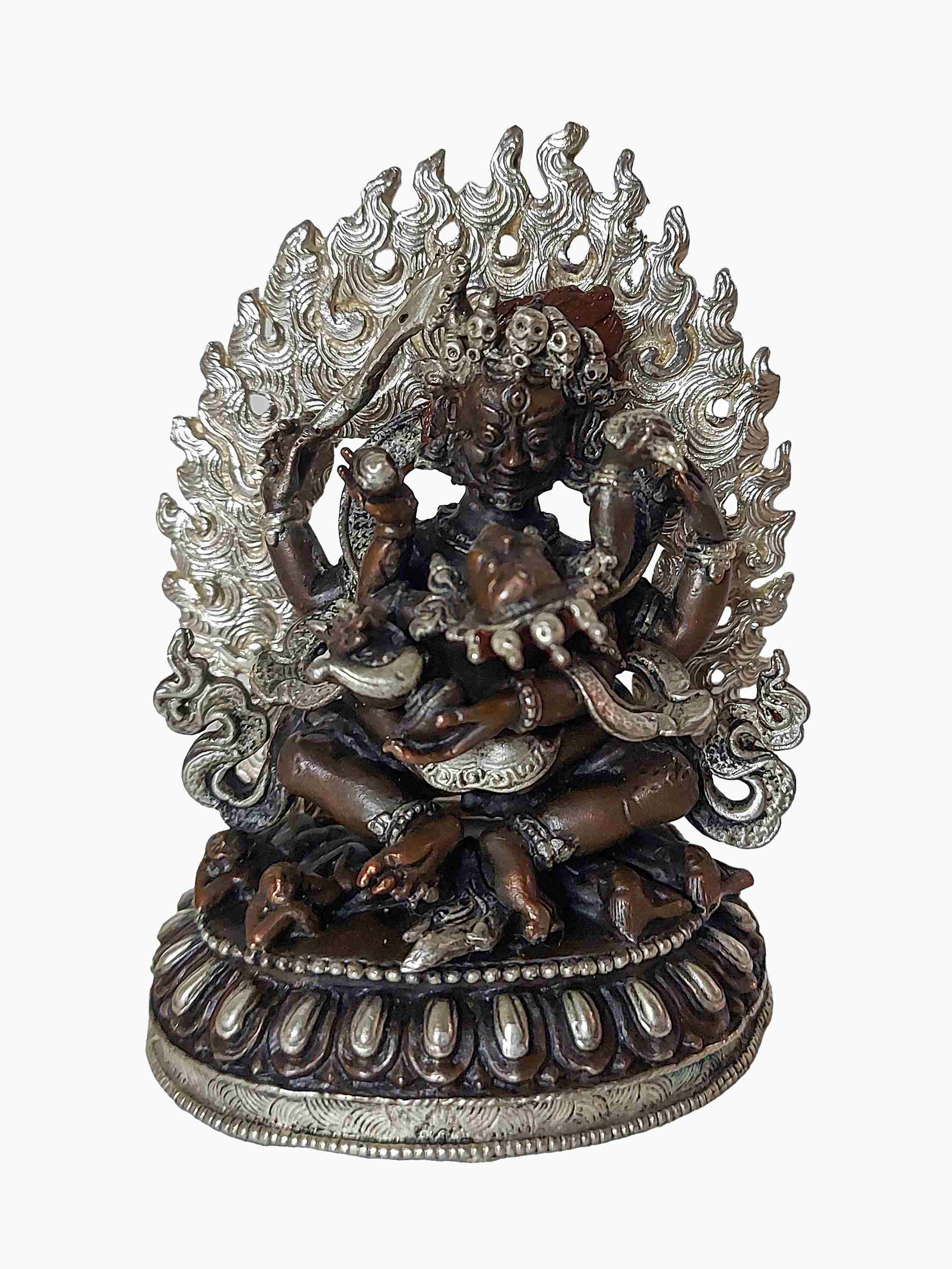


Statue of Sitting Mahakala with Consort- Four Arm with Consort, Shakti, Yab-Yum , Four-armed protector, destroys obstacles and negativity
Chagshi Zilnon
Si Bi Da Hei Tian
Shihen Daikokuten
|
|
Product Specification |
|
| Code | HME27073 |
| Size |
Height 8cm (3") Width 7cm (3") Depth 4cm (2") |
Weight | 242 gm - 0.53 lbs |
| Material | Copper |
| Availability | Available |
Order configuration (Optional)
Filling & Blessing
HIDE Select Option
Click Here to View All Option and Prices

Select

Select

Select

Select
Statue Finishing
HIDE Select Option
Click Here to View All Option and Prices

Select

Select

Select

Select

Select

Select

Select

Select

Select

Select

Select

Select

Select

Select

Select

Select

Select

Select

Select

Select

Select

Select

Select

Select

Select

Select

Select

Select

Select

Select

Select

Select

Select

Select

Select

Select

Select

Select

Select

Select
| Quantity | PCS |
US$ 75.00
$ 100.00 -25% off
Shipping Cost
|
| Price Adjustment [ Discount Ends in : 40 days ] |
||
Shipping Calculation
weight of 1 Pcs of the product is 0.5 kg and will cost USD $ 31.00
-
Item location: kathmandu, Nepal
Worldwide shipping - Dispatch
-
We normally dispatch the product in 2-5 business days. Else Buyer will be infromed personally about the dispatch Date.
- Payment
- Paypal | Credit - Debit Card | Bank Transfer | See More
- Return
- 7 days money back, buyer pays return shipping
Variations of Same Product

Welcome to Handmade Handicraft
At Handmade Handicraft, we prioritize simplicity, reflected in our user-friendly website design. We have streamlined the process so everything you need is just a click away.
While our website does not support online shopping, we've incorporated a convenient shopping cart system to assist you in sending us your inquiries. Please note, we do not process payments on our site. All transactions will be handled via email, respecting the inquiries you submit.
Should you encounter any issues while submitting your inquiries, please contact us via mobile app, email, or follow the procedure outlined below. We've provided documentation to guide you through the selection process.
selecting Procedure
In every product you will find Order Now and Quick Inquiry buttons, they are the two process of sending us your enquiry.
If you have any questions or need assistance, please don't hesitate to reach out to us. We are here to help you with your inquiries and ensure a smooth experience.
Mahakala Four Arms
Chaturbhuja Mahakala, meaning "four-armed Mahakala," is a revered deity in Tibetan Buddhism. This form of Mahakala is associated with power, protection, and the ability to overcome obstacles. With a fierce expression and a dark complexion, Chaturbhuja Mahakala is depicted with four arms, each holding significant symbolic objects. Devotees turn to this deity for guidance and assistance on their spiritual journey. Read More
Iconography:
Chaturbhuja Mahakala is depicted with a wrathful appearance. His four arms hold various symbolic attributes, including a sword in the top right hand, representing the cutting of ignorance and obstacles. The other hands may hold a trident (trishula), a skull cup (kapala), and a lasso (pasha). He typically stands atop a corpse, symbolizing the transcendence of death and impermanence.
History:
The origins of Chaturbhuja Mahakala can be traced back to ancient Indian Buddhism, where the concept of Mahakala as a wrathful deity emerged. This form gained prominence in Tibetan Buddhism and is highly revered in the Kagyu and Gelug lineages. Chaturbhuja Mahakala is seen as a guardian and protector of the teachings and practitioners.
Temples and Monasteries:
While specific temples or monasteries dedicated solely to Chaturbhuja Mahakala may not be widely known, various Buddhist monasteries and temples in Nepal, such as Boudhanath Stupa, Swayambhunath Stupa, Kopan Monastery, and Shechen Monastery, incorporate worship and reverence for Mahakala within their sacred spaces.
Benefits of practicing Chaturbhuja Mahakala:
Devotees believe that practicing Chaturbhuja Mahakala can bring protection from negative influences, removal of obstacles, and the development of inner strength and fearlessness. By connecting with this deity, practitioners seek spiritual growth, transformation, and the attainment of enlightenment.
How to practice:
Practices associated with Chaturbhuja Mahakala involve mantra recitation, visualization, meditation, and ritual offerings. Engaging in ethical conduct, cultivating compassion, and dedicating one's actions for the benefit of all beings are also important aspects of the practice.
Mantras of Chaturbhuja Mahakala:
The primary mantra associated with Chaturbhuja Mahakala is "OM BENZA MAHAKALA HUNG PHAT." Chanting this mantra with devotion and focus is believed to invoke the blessings and protective power of Chaturbhuja Mahakala. Various lineages and practices may also have their own unique mantras associated with this deity.
Chaturbhuja Mahakala is depicted with a wrathful appearance. His four arms hold various symbolic attributes, including a sword in the top right hand, representing the cutting of ignorance and obstacles. The other hands may hold a trident (trishula), a skull cup (kapala), and a lasso (pasha). He typically stands atop a corpse, symbolizing the transcendence of death and impermanence.
History:
The origins of Chaturbhuja Mahakala can be traced back to ancient Indian Buddhism, where the concept of Mahakala as a wrathful deity emerged. This form gained prominence in Tibetan Buddhism and is highly revered in the Kagyu and Gelug lineages. Chaturbhuja Mahakala is seen as a guardian and protector of the teachings and practitioners.
Temples and Monasteries:
While specific temples or monasteries dedicated solely to Chaturbhuja Mahakala may not be widely known, various Buddhist monasteries and temples in Nepal, such as Boudhanath Stupa, Swayambhunath Stupa, Kopan Monastery, and Shechen Monastery, incorporate worship and reverence for Mahakala within their sacred spaces.
Benefits of practicing Chaturbhuja Mahakala:
Devotees believe that practicing Chaturbhuja Mahakala can bring protection from negative influences, removal of obstacles, and the development of inner strength and fearlessness. By connecting with this deity, practitioners seek spiritual growth, transformation, and the attainment of enlightenment.
How to practice:
Practices associated with Chaturbhuja Mahakala involve mantra recitation, visualization, meditation, and ritual offerings. Engaging in ethical conduct, cultivating compassion, and dedicating one's actions for the benefit of all beings are also important aspects of the practice.
Mantras of Chaturbhuja Mahakala:
The primary mantra associated with Chaturbhuja Mahakala is "OM BENZA MAHAKALA HUNG PHAT." Chanting this mantra with devotion and focus is believed to invoke the blessings and protective power of Chaturbhuja Mahakala. Various lineages and practices may also have their own unique mantras associated with this deity.
Shakti
: IntroductionShakti Yab-yum is a common symbol in Nepalese and Tibetan art. It represents the primordial union of wisdom and compassion, depicted as a male deity in union with his female consort via the similar concept of interpenetration or "coalescence," as illustrated by the concept of Indra's net. The male figure represents compassion and dexterity, while the female figure represents insight. The female is seated on the male's lap in yab-yum. A rare rendition of a similar figure, but reversed, with the male sitting on the female's lap, is known as yum-yab. Read More
Silver and Chocolate Oxidized
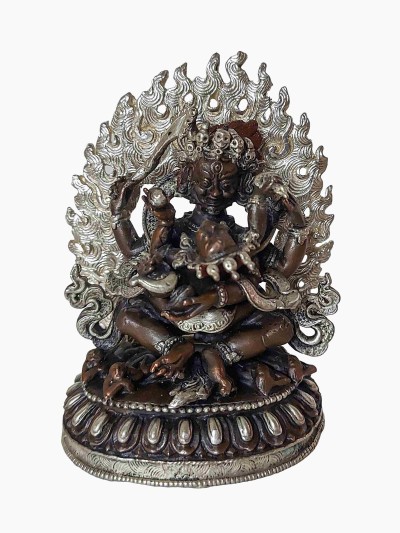
The Mahakala Four Arms features a captivating combination of partly silver plating and dark oxidation. This unique finishing technique combines the lustrous shine of silver with the rich, deep tones achieved through oxidation. In the process of creating this finish, selected areas of the Mahakala Four Arms are expertly silver-plated, creating a radiant and reflective surface that catches the light. The remaining areas are intentionally oxidized, resulting in a darkened patina that adds depth and character to the piece. Read More
Ceramic Molding System
The Mahakala Four Arms has been crafted using the Ceramic mold casting process, a modern approach that provides an alternative to traditional methods such as the lost-wax system or rubber molding. Also referred to as ceramic molding, this technique involves the creation of a ceramic mold to cast the statue. The process begins by making a precise and detailed wax model of the desired sculpture. The wax model is then coated with layers of ceramic material, creating a sturdy mold. Once the mold is complete, it is fired in a kiln, causing the wax to melt and escape, leaving behind a cavity that perfectly replicates the original sculpture. Molten metal is then poured into the mold, allowing it to fill the cavity and take on the desired form. Once cooled and solidified, the ceramic mold is carefully broken away, revealing the final metal statue. Read More
Related Products

14 cm
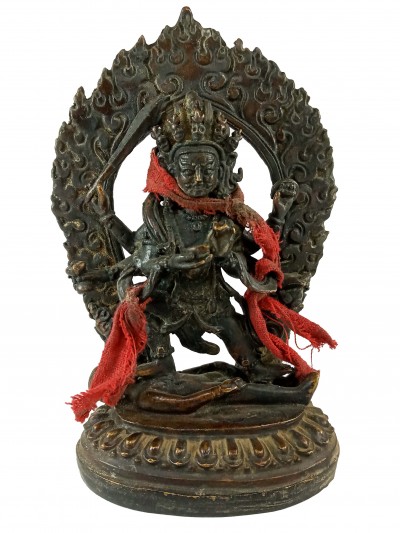
Buddhist Statue Of Mahakala Four Arms, Antique Finishing
US$ 53.00
25% off
$ 70.00
$ 70.00

28 cm
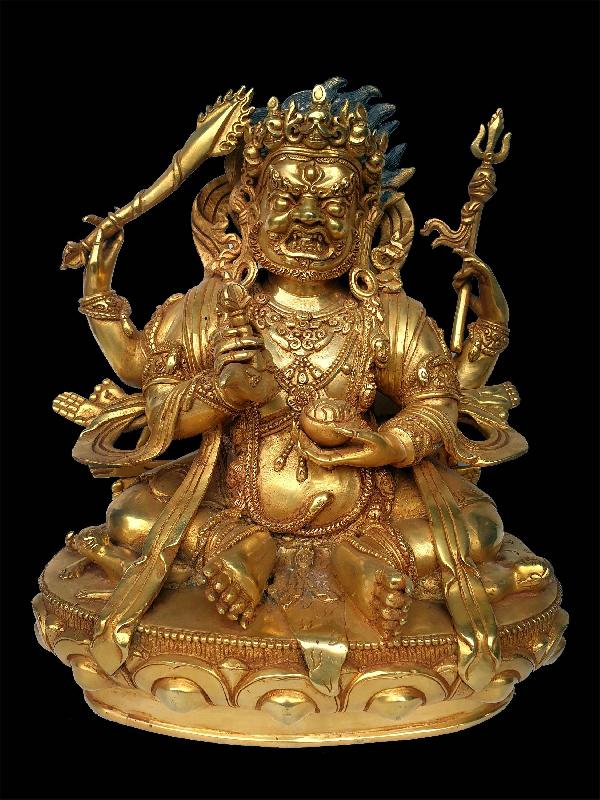
HQ, Sitting Mahakala - Four Arms Statue, Kalu Awale Copy, Full Gold Plated
US$ 810.00
25% off
$ 1,080.00
$ 1,080.00

9 cm
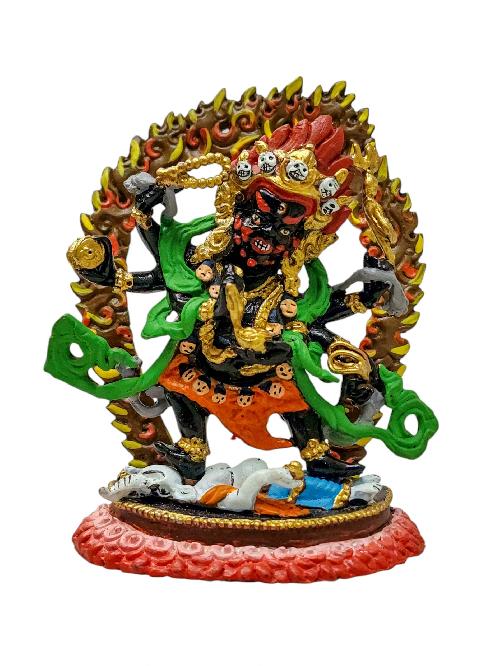
Mahakala Four Arms, Buddhist Miniature Statue, High Quality, Traditional Color Finishing
US$ 68.00
25% off
$ 90.00
$ 90.00
9 cm
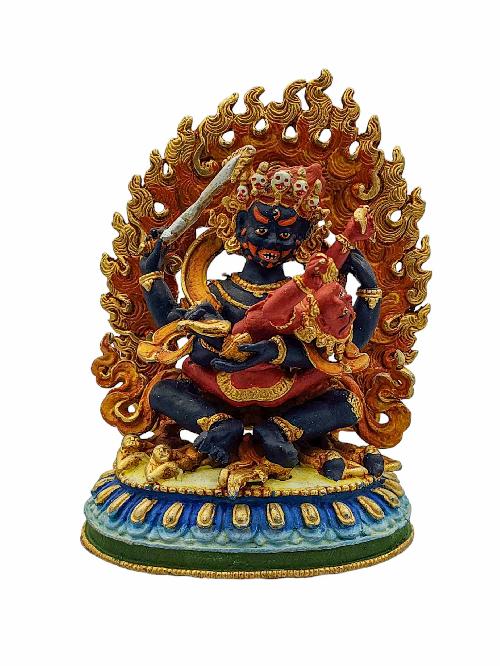
Mahakala Four Arms, Buddhist Miniature Statue, High Quality, Traditional Color Finishing, High Quality
US$ 110.00
25% off
$ 150.00
$ 150.00