Array
(
[country] => United States
[mode] => Standard
[buying_id] => 17767566693831
[c1] => show
[c2] => show
[c3] => show
[c4] => show
[c5] => show
[c6] => show
[c7] => show
[c8] => show
[c9] => show
[c10] => show
[c11] => show
[c_trigger] => no
)
At Handmade Handicraft, we prioritize simplicity, reflected in our user-friendly website design. We have streamlined the process so everything you need is just a click away.
While our website does not support online shopping, we've incorporated a convenient shopping cart system to assist you in sending us your inquiries. Please note, we do not process payments on our site. All transactions will be handled via email, respecting the inquiries you submit.
Should you encounter any issues while submitting your inquiries, please contact us via mobile app, email, or follow the procedure outlined below. We've provided documentation to guide you through the selection process.
selecting Procedure
In every product you will find Order Now and Quick Inquiry buttons, they are the two process of sending us your enquiry.
If you have any questions or need assistance, please don't hesitate to reach out to us. We are here to help you with your inquiries and ensure a smooth experience.
For Business ordering standard quantity
This website has been designed to incorporate retail and wholesale pricing in one place. You can increase or decrease the quantity based on which you will be provided with suitable prices instantly.
For Business ordering Bluk quantity [Above 100 pcs]
This is not a direct shopping website. So no payments are needed for placing an order. Please feel free to send us an order for the product you are interested in, mentioning the approximate quantity. Based on which we will send you a wholesale price quotation.
Ghau
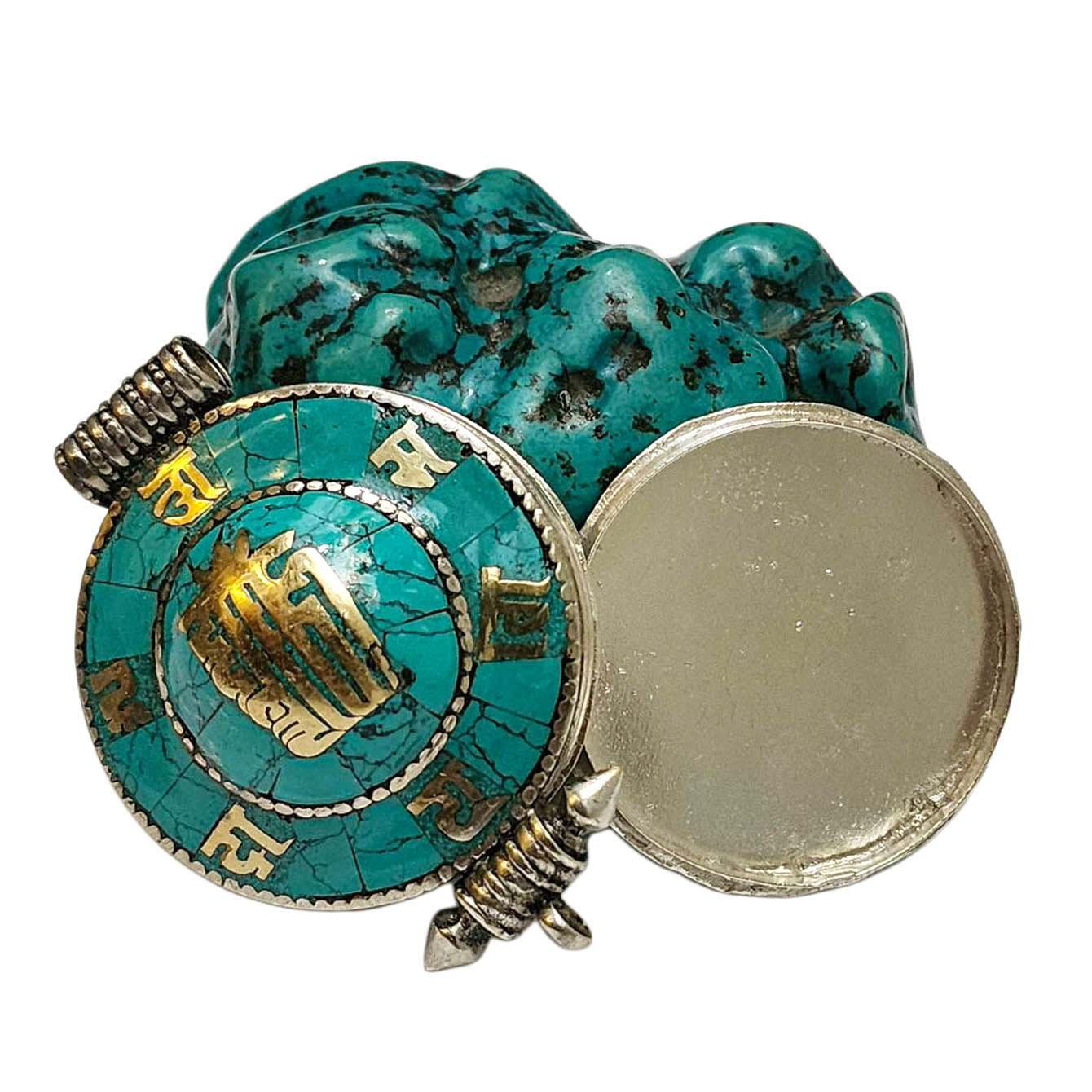
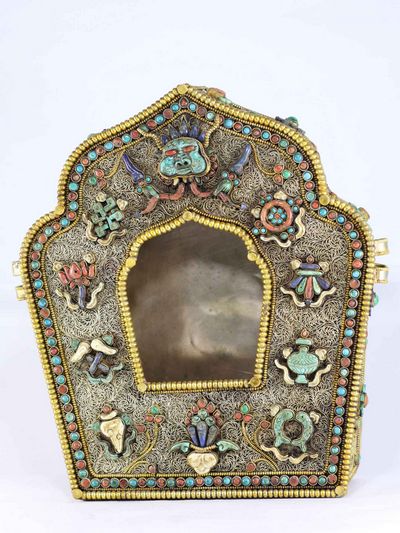
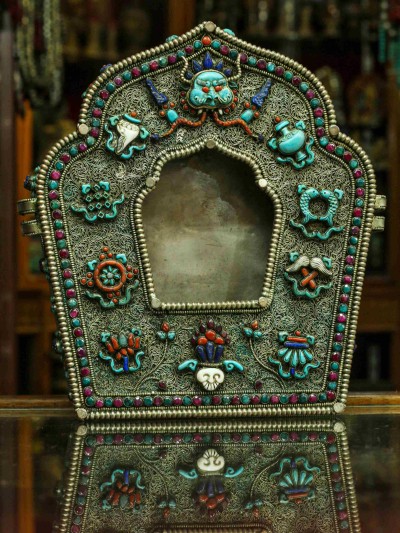
Ghau is a portable shrine in which an image of the owner's personal deity (Ishta Devata) is kept wrapped in silk cloth. Most Tibetans used Ghau at home and during traveling. At home, it is kept on alter but when traveling it is fastened at the cross belt. Generally, Ghau has trefoil shapes to and a window in the middle through which one can see the personal deity. Ghau is made of two parts which fit together to form a box. The back is usually left plain and the front is richly decorated.
Read More
OM Mani Padme Hum
: What is Om Mani Padme Hum
"Om Mani Padme Hum" is a sacred mantra in Tibetan Buddhism that holds deep spiritual significance. It is associated with Avalokiteshvara, the bodhisattva of compassion. The mantra is a powerful invocation and is believed to encompass the essence of compassion, wisdom, and enlightenment.
Each syllable of the mantra represents a specific quality:
"Om" represents the pure exalted body, speech, and mind of enlightened beings.
"Mani" symbolizes the jewel, which stands for the altruistic intention to attain enlightenment.
"Padme" means lotus and represents wisdom.
"Hum" signifies indivisibility and unity.
When reciting or meditating upon this mantra, practitioners aim to cultivate compassion, wisdom, and a deep understanding of the interconnectedness of all beings. It is believed to have the power to purify negative emotions, liberate from suffering, and lead toward enlightenment.
The mantra is often chanted, written, or inscribed on prayer flags, wheels, and stones. Its resonance and repetition are said to create positive vibrations that benefit both the practitioner and the surrounding environment.
Read More
Kalachakra
: Brief Introduction
Kalachakra means the 'Wheel of Time' & offers tools to help you free yourself from cyclical existence [Skt. Samsara]. Samsara refers to patterns of behaviour such as habits & preconceived ideas concerning the nature of reality. Each of the tools held by the deity provides a specific solution. The sum of all of Kalachakra's attributes can lead you to pure consciousness beyond the normal conception of space & time.
Iconography
The idea of Kalachakra revolves around the concept of time [Skt. Kala] and the cycles [Skt. Chakra's] of existence. Everything from the cycles of a clock, the cycles of habit, the cycles of the planets through to the cycles of human breathing. Everything is the world is governed by cycles of time & the clearer we understand cyclical patterns the more we can work with them & liberate navigate towards a more enlightened state.Kalachakra is atemporally conjoined with his consort yellow Kalachakri in an embrace called Yab-Yum. Kalachakra has four heads, 24 arms & 2 legs. A principle head is blue, with a blue upper body & four blue left & four right arms. His two principle arms embrace Kalachakri. Additionaly a left red head, four red left, four right arms & a red left leg; a white right facing head, four white right arms & a white right leg. Kalachakra is an emanation of blue Akshobhya [Skt.] [Eng. unshakable which is why Kalachakra is predominately blue. The two other original transcendent Buddha Families (Meditation [Skt. Dhyana] Buddhas) depicted are red Amitabha [Skt.] meaning bearer of love who can greed into love & white Vairochana [Skt.] meaning illuminator who can snuff out delusion into realised wisdom. The wisdom energies of ddhist ArtAmitabha, Akshobhya & Vairochana respectively transmute greed, hatred & delusion tuning the Wheel of Life. His crossed two principle blue arms are in Victory over the Three Realms gesture [Skt. Triolyavijaya Mudra], also called the Humkara Mudra with reference to the syllable 'Hum'. The three realms form the Trikaya Principle of Nirmanakaya, Sambhogakaya & Dharmakaya. The right hand holds a vajra topped bell [Skt. Ghanta] (barely visible) symbolising female wisdom & a diamond [Skt. Vajra] sceptre which symbolises method or compassion. He wears a special necklace of interlocking Diamond Sceptres [Skt. Vajramala] & a second made of skulls [Skt Kapalamala]. He wears a tiger skin dhoti representing his power over hatred. He stands & subdues two four armed demons. One of his left hands holds a blue wooden club [Skt. Danda] representing the crushing of the veils of ignorance. The top left red hand holds a hammer [Skt. Mudgara] representing the destruction of greed. The head of the hammer is bell-shaped symbolising the female wisdom quality, the vajra-shaped back part representing the male method quality & surmounted by a jewel representing conviction. The third red left hand holds an iron hook [elephant goad] with a vajra pommel [Skt. Vajrankush] which represents subjugating negative afflictions. The fourth red hand holds three unkindled firebrands [Skt. Agnidanda or Jvaladanda] often shown as three fire arrows [Skt. Agnibana] representing the power of subjugating the three original Kleshas being greed, hatred & delusion which form the centre of the Wheel of Life.
The top right white hand holds the Four Heads of Brahma [Skt. Brahmashiras] representing the severance of all conceptualisations & development of the four measureless states being loving kindness [Skt. Metta], sympathetic joy [Skt. Mudita], equanimity [Skt. Upekka] & lastly compassion [Skt. Karuna] which themselves know no bounds. The Four abodes are also known as the Temples of Brahma. The third white hand holds a sun disc [Skt Suryachakra] representing absolute truth with the third blue hand holding a moon disc representing awoken realisation of relative truth. His fourth right white hand holds the right turning conch shell [Skt. Dakshinavarta Sangha] representing sound & the seed [Skt. bija] syllables, Buddhism according to the Dharmas. Descriptions the other shown hand-held attributes are found in Robert Beer's book The Handbook of Tibetan Symbols. The triangular diamond rock formation in the foreground represents the Source of Reality [Skt. Dharmadaya] within which the deities manifest & the principle of Trikaya arises. This is generated from emptiness by the syllable E which in Indian language is a Triangular shaped letter D.
Commentary
Yab-Yum is a Tibetan word meaning father-mother which describes Kalachakra in sexual union with his female consort Kalachakri. Yab-yum is generally understood to represent the primordial union of wisdom & compassion. In Buddhism the masculine form is active, representing either skilful means or compassion [Skt. Upaya] that should be developed for enlightenment. The feminine form is passive representing wisdom [Skt. Prajna]. United, the figures symbolize the union necessary to overcome the veils of Maya, the false duality of object & subject. Kalachakra is also a tutelary meditation[Skt. Ishtadevata; Tib. Yidam] deity.
Mantra of Kalachakra
OM AH HUM HOH HAM KSHAH MA LA VA RA YA HUM PHET
Read More
Turquoise
: Brief Introduction
Turquoise is a purification stone. It dispels negative energy and can be worn to protect against outside influences or pollutants in the atmosphere. Turquoise balances and aligns all the chakras, stabilising mood swings and instilling inner calm. It is excellent for depression and exhaustion, it also has the power to prevent panic attacks. Turquoise promotes self-realisation and assists creative problem solving. It is a symbol of friendship, and stimulates romantic love.
Turquoise aids in the absorption of nutrients, enhances the immune system, stimulates the regeneration of tissue, and heals the whole body. It contains anti-inflammatory and detoxifying effects, and alleviates cramps and pain. Turquoise purifies lungs, soothes and clears sore throats, and heals the eyes, including cataracts. It neutralises over acidity, benefits rheumatism, gout, stomach problems, and viral infections
Turquoise is a mineral that is a hydrous phosphate of copper and aluminium. Turquoise is an 11th Anniversary gemstone.
Chakras - Heart Chakra, Throat Chakra, Third Eye Chakra
Birthstone - December (Blue Turquoise)
Zodiac - Scorpio, Sagittarius, Aquarius, Pisces
Planet – Venus & Neptune
Element – Earth/Air/Fire
Vibration - Number 1
Typical colours - Turquoise, blue, green, yellow-green
Read More
Finishing: Stone Setting
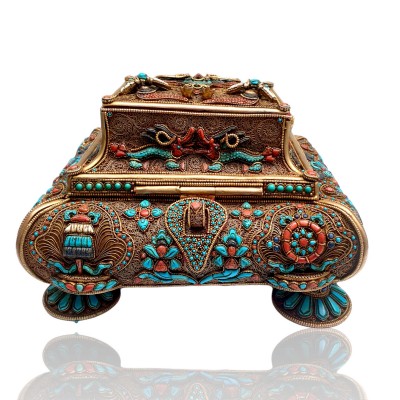
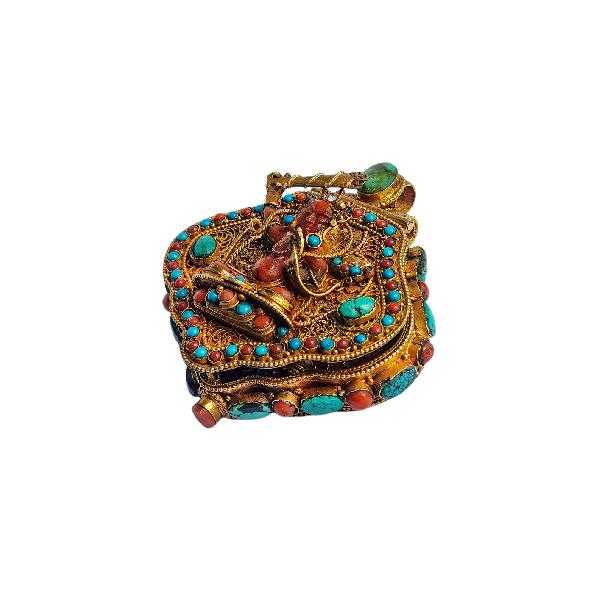
The Ghau is adorned with an exquisite array of semi-precious stones, including turquoise, coral, and lapis lazuli. These stones are carefully selected and meticulously placed on the Ghau's surface, adding a touch of opulence and enhancing its overall beauty. Each stone is thoughtfully positioned using a high-quality adhesive, ensuring secure and long-lasting attachment. The vibrant colors and unique patterns of the stones create a captivating contrast against the backdrop of the Ghau, elevating its visual appeal and making it truly eye-catching.
Beyond their decorative purpose, these semi-precious stones carry symbolic significance in various cultures and traditions. Turquoise is often associated with protection and healing, coral represents vitality and passion, while lapis lazuli symbolizes wisdom and truth. The inclusion of these stones not only adds to the aesthetic allure of the Ghau but also imbues it with deeper meaning and cultural symbolism.
The intricate placement of these semi-precious stones showcases the meticulous craftsmanship and attention to detail that goes into the creation of the Ghau. It is a testament to the skill and artistic vision of the artisans who delicately adorn the statue, resulting in a truly remarkable and captivating piece of art.
Read More
Related Products
HME15288
25.5 cm Copper Handmade Ghau Silver Plated, with Real Stones