Black Mahakala is a prominent deity in Tibetan Buddhism, known for his fierce and wrathful form. Also called Bernakchen, he is revered as a protector and remover of obstacles. Black Mahakala is often depicted with a dark blue or black complexion, standing on a corpse, and wearing a crown of five skulls. He holds a trident, a skullcup, and a curved knife, symbolizing his power to destroy ignorance and negativity. Devotees believe that practicing Black Mahakala can help overcome obstacles, dispel negative energies, and cultivate inner strength and wisdom.
Iconography:
Black Mahakala is typically depicted with a fierce expression, dark blue or black, symbolizing his wrathful nature. He stands on a corpse, representing his triumph over death and impermanence. He has four arms, each holding a symbolic object. His main right hand wields a trident, representing his power over the three poisons of ignorance, attachment, and aversion. In his main left hand, he holds a skull cup filled with blood, symbolizing the transmutation of negative emotions. His remaining two hands hold a curved knife, representing the severance of ignorance, and a lasso, symbolizing the binding of negative forces.
History:
The origin of Black Mahakala can be traced back to ancient Indian Buddhism. In Tibet, he is considered to be an emanation of the Bodhisattva Avalokiteshvara, who embodies compassion. Black Mahakala became particularly popular during the time of the great Indian teacher Padmasambhava, who introduced tantric Buddhism to Tibet. Over the centuries, he gained significance as a protector deity in the Tibetan Buddhist tradition, and his practice spread widely throughout the region.
Temples:
Black Mahakala is widely revered in Nepal, and there are several temples dedicated to him. One notable temple is the Mahakala Temple in Patan, Nepal. Situated in the Patan Durbar Square, it is a sacred place where devotees gather to offer prayers and perform rituals to Black Mahakala. Another important temple is the Mahakala Temple in Kathmandu, located near the popular pilgrimage site of Swayambhunath Stupa. Both of these temples are significant pilgrimage sites for followers of Tibetan Buddhism.
Benefits of Practicing Black Mahakala:
The practice of Black Mahakala offers numerous benefits to practitioners. By connecting with this deity, individuals can overcome obstacles, both external and internal. Black Mahakala's wrathful form represents the transformative power to annihilate ignorance and destructive forces within oneself. Through devotion and practice, one can cultivate courage, inner strength, and wisdom. Additionally, practicing Black Mahakala is believed to purify negative karma, protect against harm, and promote spiritual growth on the path to enlightenment.
How to Practice:
The practice of Black Mahakala involves various aspects, including visualization, mantra recitation, and ritual offerings. Devotees often begin by visualizing Black Mahakala in front of them, vividly imagining his fierce form and the surrounding environment. Mantra recitation is an integral part of the practice, with the primary mantra being "OM BENZA MAHAKALA HUM PHAT," chanted repeatedly. Ritual offerings such as incense, flowers, and food can be made to Black Mahakala, expressing devotion and generating positive merit. Engaging in this practice regularly with sincerity and dedication deepens the connection with the deity.
Mantras of Black Mahakala:
The primary mantra associated with Black Mahakala is "OM BENZA MAHAKALA HUM PHAT." This mantra is recited to invoke the blessings and protection of the Black Mahakala. By chanting this mantra, devotees seek the removal of obstacles, the dispelling of negativity, and the cultivation of inner strength and wisdom. Along with the main mantra, there are other mantras and prayers specific to Black Mahakala's practice that can be found in Tibetan Buddhist texts and teachings. These mantras are considered potent tools for connecting with the deity and cultivating a deeper spiritual relationship.
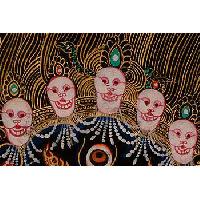 The Five Skull Crown | He is adorned with the following symbolic attributes:
1). A crown of five skulls: This is worn by all manifestations of Mahakala and represents the transmutation of the five negative afflictions of human nature into positive virtues. Thus:
a). Ignorance transforms into the wisdom of reality.
b). Pride becomes the wisdom of sameness.
c). Attachment becomes the wisdom of discernment.
d). Jealousy becomes the wisdom of accomplishment.
e). Anger becomes mirror like wisdom. |
| |
2). The Six Arms signify the successful completion of the six perfections (shad-paramita), which are practiced and brought to perfection by bodhisattvas during the course of their training. These are:
a). The perfection of generosity (dana-paramita)
b). Morality (shila-paramita)
c). Peace (shanti-paramita)
d). Vigor (virya-paramita)
e). Meditation (dhyana-paramita)
f). Insightful Wisdom (prajna-paramita) |
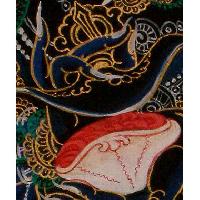 The Skull Cup and Chopper |
3). The arms hold various implements each of which has a symbolic significance:
a). The first right hand holds a curved knife. In Mahakala's symbolism the curved knife cuts through the life veins of enemies such as oath-breakers and hindering spirits.
b). The skull cup in his primary left hand is filled with the heart-blood of these enemies. The crescent shaped chopper of the right hand corresponds in shape to the cavity of the skull cup and functions to make 'mincemeat' of the hearts, intestines, lungs, and life-veins of enemies hostile to the Dharma, which are then collected in the skull cup. A similar crescent shaped hand cleaver is used in oriental cuisine to chop meat and dice vegetables. |
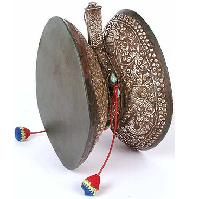 Ritual Damaru | The next right hand holds a damaru - the hourglass-shaped drum, signifying the primordial sound from which is said to have originated all manifested existence. Its rattle is also said to emanate the sound that arouses us from our ignorant state, coaxing us on to the path of Dharma. |
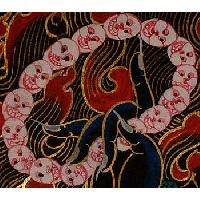 The Rosasry of Skulls |
d). The uppermost right hand holds a rosary of skulls. The continuous counting of the rosary is a symbol of perpetual activity, which Mahakala achieves on a cosmic scale. |
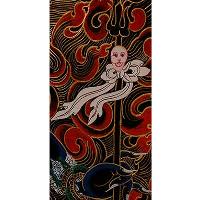 The Trident |
e). Another left hand holds a trident which represents the Three Jewels of Buddhism, the Buddha, the Dharma, and the Sangha. |
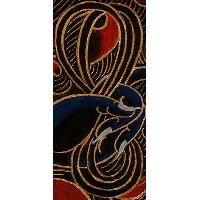 The Lasso |
f). Finally there is the noose for lassoing those of us who have strayed away from the path of the Dharma. |
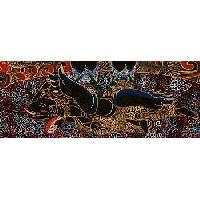 One Elephant Under Mahakala's Feet | The Six-armed Mahakala's left leg is outstretched while the right is bent at the knee. The former symbolizes his accomplishments for the benefit of others and the latter those for himself. An elephant-headed entity lying crushed under his legs represents our instinctive, primary animal force and urge, which when unleashed can prove to be extremely destructive. These cravings however, can also be extremely useful to our self-development and -realization when we master them and bring them under our moderation. Indeed, it is warned that dreaming about a herd of elephants is a sign that instinctive and irrepressible forces that may have been suppressed for too long are about to be unleashed. |
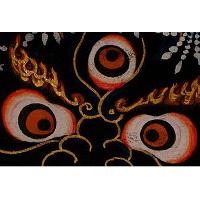 The Three Wide Open Eyes | The sun-disc on which Mahakala stands denotes his illumination of the darkness of ignorance, and the lotus on which this disc rests signifies his undefiled purity. The blazing fire surrounding him demonstrates his powerful energy out to consume all neurotic states of minds. Further, his three organs of vision express his ability to see the past, present and future. That he stares at the world with wide eyes signifies that he is incensed at the current state of affairs. Snakes slither across his body as ornaments and also as the scared thread of Brahmins. The writhing serpent is a metaphor for the stirring of our psychic instinctive and primordial energy and Mahakala's wearing them as adornments expresses the fact that rather than impede our spiritual progress, such emotions have been tamed and harnessed, becoming in the process, crowning glories of our spiritual achievements. |

